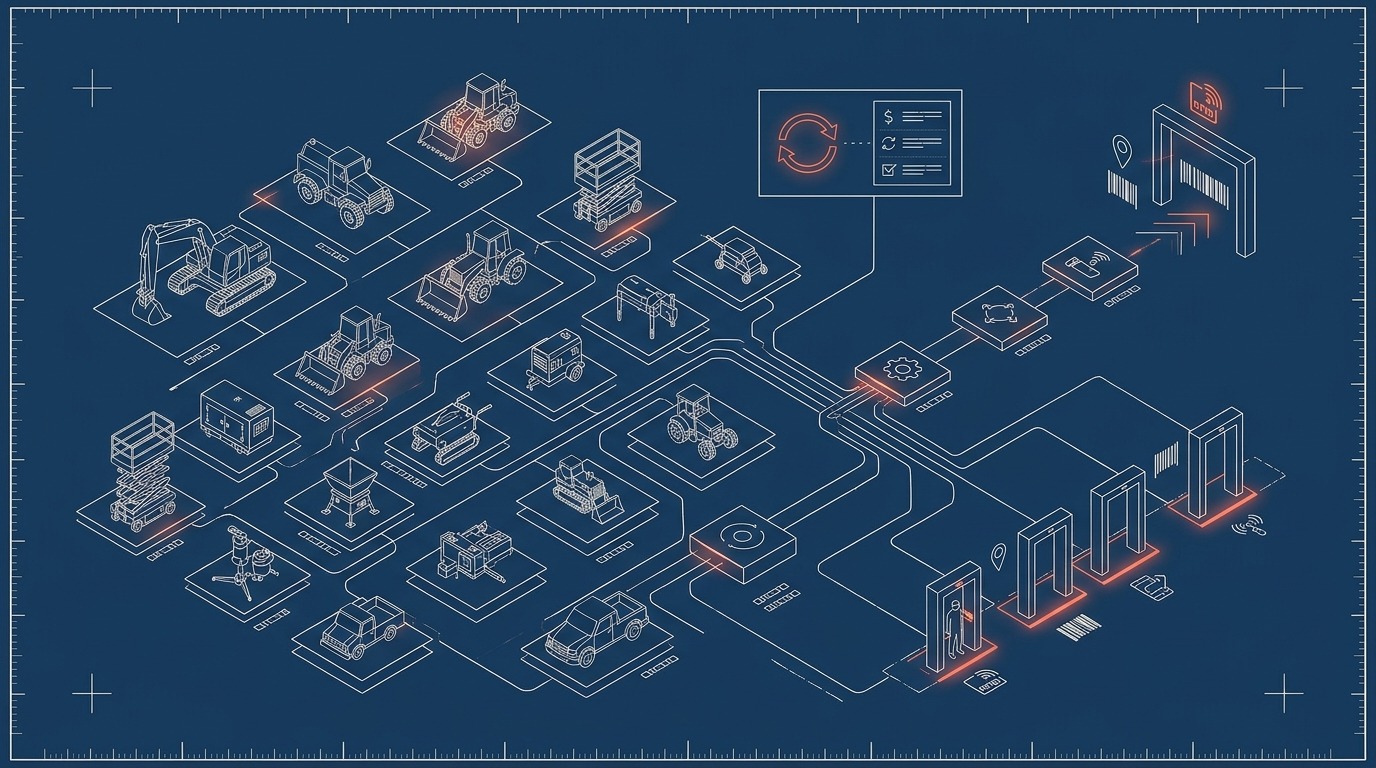
Equipment Rental Management Software: Handling 1,000+ Active Contracts Without Billing Errors or Lost Assets
Equipment rental businesses run on asset utilisation and contract accuracy. Every hour a piece of equipment sits idle because its availability status is wrong in your records costs you revenue. Every invoice sent without the correct rental period, the right damage charges, or the agreed contract terms costs you margin and creates a dispute. These problems don’t happen once. They happen repeatedly, across every contract in your portfolio, every month.
For rental businesses managing more than a few dozen active contracts, spreadsheet-based tracking and manual invoicing are no longer viable. The question isn’t whether to move to a dedicated equipment rental management system. It’s how long you can afford to wait before the errors and asset gaps become serious enough to force the decision.
The Four Operational Failures in Manual Equipment Rental Management
Asset Tracking Blind Spots
When equipment availability is tracked in a spreadsheet or a basic calendar system, the data is only as accurate as the last update. Equipment that’s been returned is still showing as rented out. Equipment that’s under maintenance shows as available. A customer calls to book a crane for next week and you commit to the booking, only to discover, when you go to arrange delivery, that the crane is still on a site in Jurong.
For rental businesses with diverse fleets (scaffolding, construction equipment, audio-visual gear, event furniture, industrial machinery), the asset tracking complexity scales with the number of items and the number of concurrent rentals. Manual systems break down at scale. The question is which rental business reaches that scale first: yours or your competitor’s.
Contract Management Complexity
Equipment rental contracts are not simple. They include rental periods, extension options, damage clauses, consumable charge-outs, delivery and collection fees, and specific conditions that vary by customer and by equipment type. When contracts are managed in email threads and paper documents, critical terms get lost. Extension requests get processed but the contract isn’t updated. Damage charges that should be applied when equipment is returned are missed because the person doing the return check isn’t the same person who manages billing.
The downstream effect of contract management gaps is billing disputes. The customer’s records say one thing; your records say another. Resolving the dispute takes management time and damages the customer relationship, regardless of who was right.
Maintenance Scheduling and Downtime
Equipment that breaks down on a customer’s site creates a problem at two levels: the customer’s operations are disrupted, and you’ve just incurred an emergency repair cost without warning. Scheduled preventive maintenance (service intervals based on usage hours or elapsed time) is the mechanism that prevents this. When maintenance scheduling is manual, it gets missed. The equipment goes out one more time before the scheduled service, the scheduled service date passes during a busy period, and the failure happens on site.
For equipment with odometer or hour-meter tracking (generators, compressors, vehicles, lifting equipment), usage-based maintenance intervals are more accurate than time-based ones. A manual system can’t track real-time usage against maintenance intervals. A purpose-built rental system can.
Invoicing Errors and Revenue Leakage
Manual invoicing from rental contracts creates systematic revenue leakage. Rental periods that run a day or two over the booked period don’t get billed because no one noticed the extension. Damage charges that were agreed at equipment return don’t make it onto the invoice because the information didn’t transfer from the operations team to the billing team. Consumable usage that was tracked on the job site doesn’t appear in the final invoice.
Each missed charge is small individually. Across a portfolio of active contracts, the total is significant. And unlike a disputed charge that the customer pushes back on, missed revenue from billing gaps is invisible, you never know it was there.
What Equipment Rental Management Software Delivers
Real-Time Asset Availability
A dedicated rental management system maintains a live availability calendar for every item in your fleet. When a rental is confirmed, the equipment is blocked for that period automatically. When it’s returned and checked in, it becomes available immediately, or moves to a maintenance queue if service is due. Your team books equipment against real availability, not a spreadsheet that may or may not be current.
For businesses managing similar items (multiple units of the same scaffold type, multiple generators of the same specification), the system tracks each unit individually, with its own maintenance history, rental history, and current location. You can answer the question ‘How many 50kVA generators are available next Tuesday?’ in seconds, without making calls to the yard.
Automated Quotation-to-Cash Workflow
When a customer requests a rental, the system generates a quotation automatically from the asset details and the applicable rate card. Once approved, the quotation converts to a rental contract with digital approval. At the end of the rental period, the system calculates the invoice based on the actual rental period, any approved extensions, damage charges recorded at return, and consumable usage, and generates the invoice automatically.
The manual steps that create billing errors (calculating the rental duration, remembering to add the damage charges, including the delivery fee) are eliminated. The invoice is generated from the contract and the return record, not from someone’s notes.
Smart Contract Lifecycle Management
Contract management in a dedicated system covers the full lifecycle: quotation, contract creation with digital approval, active rental tracking, extension management, early return processing, damage assessment, and final settlement. Every change to a contract is recorded with a timestamp and the identity of the person who made it. When a customer disputes a charge, you have a complete contract history that shows every agreed term and every modification.
Contract renewal automation flags upcoming contract end dates for follow-up before equipment is collected. For customers with recurring rental needs, renewal is a one-click process rather than starting from scratch.
Maintenance Hub and Spare Parts Tracking
Every piece of equipment in the fleet has a maintenance record in the system: service history, upcoming maintenance intervals (by date or usage hours), spare parts consumed in previous services, and current condition rating. When an item comes off rental, the system checks whether it’s due for service before the next rental period. If it is, it’s automatically queued for maintenance rather than being made available for booking.
Spare parts consumption per service is tracked against inventory, triggering reorder when parts fall below minimum stock levels. You don’t discover that a critical part is out of stock when equipment is already broken down on a customer’s site.
Delivery and Return Order Management
Delivery and collection logistics (scheduling, route planning, driver assignment, proof of delivery, condition documentation at delivery and return) are managed within the same system. At delivery, the driver records the equipment condition with photos. At return, the same documentation process captures any damage. The condition records at both points are linked to the contract and are available when the final invoice is generated, making damage charge disputes straightforward to resolve.
What the Numbers Show
Businesses running Moxogo’s Equipment Rental Management solution are managing an active portfolio of 1,284 contracts, with a +12% growth indicator reflecting the capacity that automated contract management creates. Implementation runs on a structured six-week timeline across clearly defined phases: system configuration and data migration in weeks one and two, parallel running in weeks three and four, and full cutover in weeks five and six.
The six-week implementation timeline is achievable specifically because the system is purpose-built for equipment rental workflows. The configuration work involves mapping your existing contract templates, rate cards, and equipment fleet into the system, not starting from a blank ERP and configuring it for rental from scratch.
Who Benefits Most from Equipment Rental ERP
The strongest case for dedicated rental management software exists when:
- Your active contract count is above 50, at this volume, manual tracking creates daily errors
- You manage multiple equipment categories with different rate structures and contract terms
- Your fleet includes items that require usage-based maintenance scheduling
- You have multiple collection and delivery points and need to coordinate fleet logistics
- Billing disputes are a recurring issue with customers who have their own contract records
Getting Started
Moxogo’s Equipment Rental Management solution integrates CRM, Sales Management, Invoicing, Purchase Management, Inventory, and a purpose-built rental engine in a single platform. Implementation follows a structured six-week methodology with expert-led deployment, data migration support, and staff training.
For businesses currently managing contracts in spreadsheets or disconnected systems, a 30-minute consultation will clarify whether your current approach is creating the revenue leakage and operational complexity that rental management software is designed to eliminate.
More Articles
Team Human and the Pro-Human AI Declaration, Fact-Checked: What Two Campaigns Say and What Holds Up
Two 2026 campaigns ask who stays in charge of AI: Team Human wants a global slowdown, the Pro-Human AI Declaration sets 33 principles. We read both so...
Read Article
Preschool and Childcare Management Software Singapore: From Enrolment to Fee Collection Without the Paperwork
Why Childcare Centres Need Better Systems Singapore’s early childhood education sector is growing, government subsidies, rising enrolment rates,...
Read Article
The Pro-Human AI Declaration for Business: 33 Principles and What Each Means for a Small Company
The Pro-Human AI Declaration has 33 principles. Which ones can a small business act on? Each principle in plain words, with a 15-question self-check, ...
Read Article