Omnichannel Retail ERP for Singapore SMEs: Real-Time Inventory Across Every Sales Channel
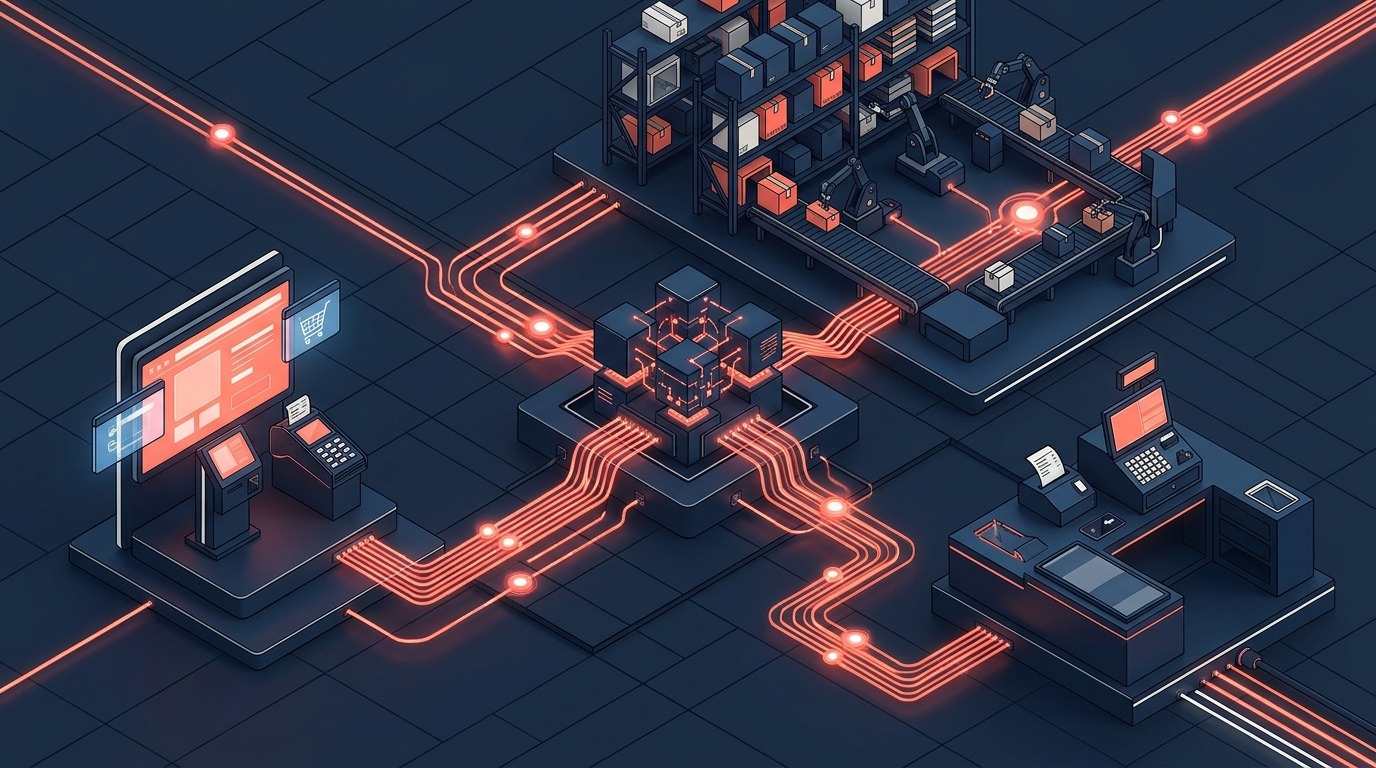
Singapore’s retail environment has made channel fragmentation the default operating reality for most retail SMEs. Businesses that started as physical stores now sell on Shopee, Lazada, their own website, and potentially through B2B accounts to corporate clients, all simultaneously. Each channel has its own order management interface. Each has its own inventory view. And the problem that emerges when you’re managing them separately is the same one every multi-channel retailer eventually hits: a customer buys the last unit on Lazada and a customer in-store tries to buy the same unit at the same moment.
Overselling is the visible symptom. But the underlying issue is that inventory exists in multiple isolated pools instead of a single unified pool distributed intelligently across channels. Fixing the overselling problem means fixing the inventory architecture. That requires an omnichannel ERP, not a better spreadsheet.
What Multi-Channel Retail Without Integration Actually Costs
Inventory Fragmentation and Stockouts
When each sales channel has its own inventory allocation (fixed quantities reserved for the physical store, fixed quantities for Shopee, fixed quantities for Lazada), you’re never actually selling from a unified pool. Products sell through faster on one channel than expected, and you hit zero on that channel while inventory sits allocated to another. The customer who wanted to buy on your website can’t, because your website shows zero stock, even though you have 30 units sitting at the warehouse earmarked for the slow channel.
The alternative (over-allocating to each channel as a buffer) ties up working capital in excess inventory. You’re either understocked on the fast channel or overstocked overall. Neither is a sustainable model.
Inconsistent Customer Experience
When a customer buys online and wants to return in-store (a standard expectation for Singapore retail customers), a disconnected system can’t look up the online order at the POS terminal. The return requires manual processing, takes longer than it should, and creates a customer experience friction point that reflects on your brand regardless of how good your products are.
Similarly, a customer who accumulates loyalty points in-store and expects to use them online, or who placed an online order and calls to add an item to it; these are standard customer service requests that disconnected systems can’t handle smoothly. Each failed attempt at a cross-channel interaction is a reminder to the customer that your operation isn’t as seamless as your competitors’ who have solved this.
Manual Inventory Reconciliation
When inventory is tracked separately per channel, the periodic reconciliation of stock across all channels is a manual exercise. Someone pulls the numbers from each channel’s backend, compiles them into a spreadsheet, reconciles against the warehouse count, and produces a number that’s already outdated by the time it’s compiled. This reconciliation typically happens weekly at best, meaning decisions about restocking, promotions, and channel allocation are made on week-old data.
Reporting Complexity and Blind Spots
When sales data is distributed across multiple channel backends, meaningful cross-channel reporting, total revenue by product, gross margin by channel, which products are performing across all channels vs. on one only, requires someone to extract data from each system and consolidate it manually. Most retail SMEs simply don’t do this analysis because it takes too long. They fly blind on cross-channel performance data and make restocking and promotional decisions based on single-channel visibility.
What Omnichannel Retail ERP Actually Delivers
Unified Inventory Pool
In an omnichannel ERP, there is one inventory pool for every SKU. When a unit sells on Lazada, the warehouse inventory decrements immediately. When a unit sells at the POS in your physical store, the same pool updates immediately. When the warehouse receives a new delivery, available quantity increments across all channels simultaneously.
Channel-specific inventory allocation (where you choose to reserve a certain quantity for a specific channel during a promotion) is configurable. But the default is a single pool, giving you maximum flexibility to fill orders from wherever they come without artificial scarcity created by channel silos.
Advanced POS with Multi-Location Support
A retail ERP’s POS module is designed for the realities of multi-outlet retail: real-time stock visibility across all locations at the point of sale, ability to fulfil from another outlet if the current one is out of stock, cross-location customer record and loyalty programme access, and end-of-day reconciliation that feeds directly into the central accounting system without manual re-entry.
For retail businesses with both physical stores and online channels, the POS is the integration point where staff should have the same customer profile visibility as the online system. A returning customer at the POS should be identifiable, with their purchase history and loyalty balance visible, in the same way they are when they log into the online store.
E-Commerce and Marketplace Integration
Direct integration with Shopee, Lazada, and the business’s own website means orders from all channels flow into a single order management dashboard. Staff process all orders from one interface rather than logging into each platform separately. Order status updates sync back to each marketplace automatically, reducing the manual work of updating tracking information across platforms.
Pricing and promotions can be managed centrally and pushed to all channels simultaneously, or set differently per channel based on strategy. When a flash sale goes live on one channel, the inventory depletion is immediately visible across all others, preventing overselling regardless of the order sequence.
Customer Loyalty and CRM
A retail ERP consolidates customer purchase history across all channels into a single profile. Loyalty points earned online are redeemable in-store and vice versa. Customer segmentation (by purchase frequency, average order value, category preference) is available across the full purchase history rather than being limited to one channel’s data. Marketing campaigns based on this segmentation have the complete customer picture, not a partial view from a single channel.
Real-Time Analytics and Sales Forecasting
Sales performance by product, by channel, by location, and by time period is available in real time from a single dashboard. Sell-through rates by SKU identify slow-moving stock before it becomes a clearance problem. Reorder points triggered by actual consumption rather than manual review ensure that fast-moving products don’t stockout. Seasonal demand patterns, visible across historical data for all channels, improve buying decisions for the next season.
For retail SMEs in Singapore that currently manage reporting by extracting and combining data from multiple channel backends, this shift from retrospective to real-time analytics is substantial. Decisions about which products to restock, which to promote, and which to clear happen faster and with better information.
Implementation Timeline for Singapore Retail Businesses
The Moxogo Retail Management implementation follows a 12-week structured rollout. The extended timeline relative to simpler ERP implementations reflects the complexity of channel integration: each marketplace and e-commerce platform requires configuration and testing to ensure order flow, inventory synchronisation, and pricing updates work correctly before go-live.
The typical sequence: weeks one through four for system configuration, product catalogue migration, and channel integration setup; weeks five through eight for staff training and parallel running; weeks nine through twelve for phased channel go-live, starting with the highest-volume channel and progressively adding others once the first is stable.
The Results Singapore Retailers Are Achieving
- 40% sales increase for multi-store operations, driven by unified inventory availability and cross-channel fulfilment capability
- 98% stock accuracy across all locations, replacing the 90-95% accuracy typical in manually managed multi-channel inventory
- Improved customer retention through loyalty programmes that work seamlessly across channels
- Faster checkout and reduced abandonment at POS through improved system reliability and speed
When to Move to Omnichannel Retail ERP
The threshold that consistently triggers the move is when managing inventory across channels is taking more time than selling. When the reconciliation process is a significant weekly time commitment, when overselling incidents are happening monthly, or when you’ve had to decline a wholesale or B2B opportunity because you couldn’t give the buyer real-time inventory visibility; these are the signals that the current architecture has reached its limit.
Getting Started
Moxogo’s Retail Management solution covers omnichannel inventory management, advanced POS for multi-location retail, e-commerce and marketplace integration, customer loyalty and CRM, staff management, and full financial integration, in a single platform that eliminates the channel silos driving operational complexity.
More Articles
Team Human and the Pro-Human AI Declaration, Fact-Checked: What Two Campaigns Say and What Holds Up
Two 2026 campaigns ask who stays in charge of AI: Team Human wants a global slowdown, the Pro-Human AI Declaration sets 33 principles. We read both so...
Read Article
Preschool and Childcare Management Software Singapore: From Enrolment to Fee Collection Without the Paperwork
Why Childcare Centres Need Better Systems Singapore’s early childhood education sector is growing, government subsidies, rising enrolment rates,...
Read Article
The Pro-Human AI Declaration for Business: 33 Principles and What Each Means for a Small Company
The Pro-Human AI Declaration has 33 principles. Which ones can a small business act on? Each principle in plain words, with a 15-question self-check, ...
Read Article