Why Do Event Companies Outgrow Spreadsheets Faster Than Other Businesses?
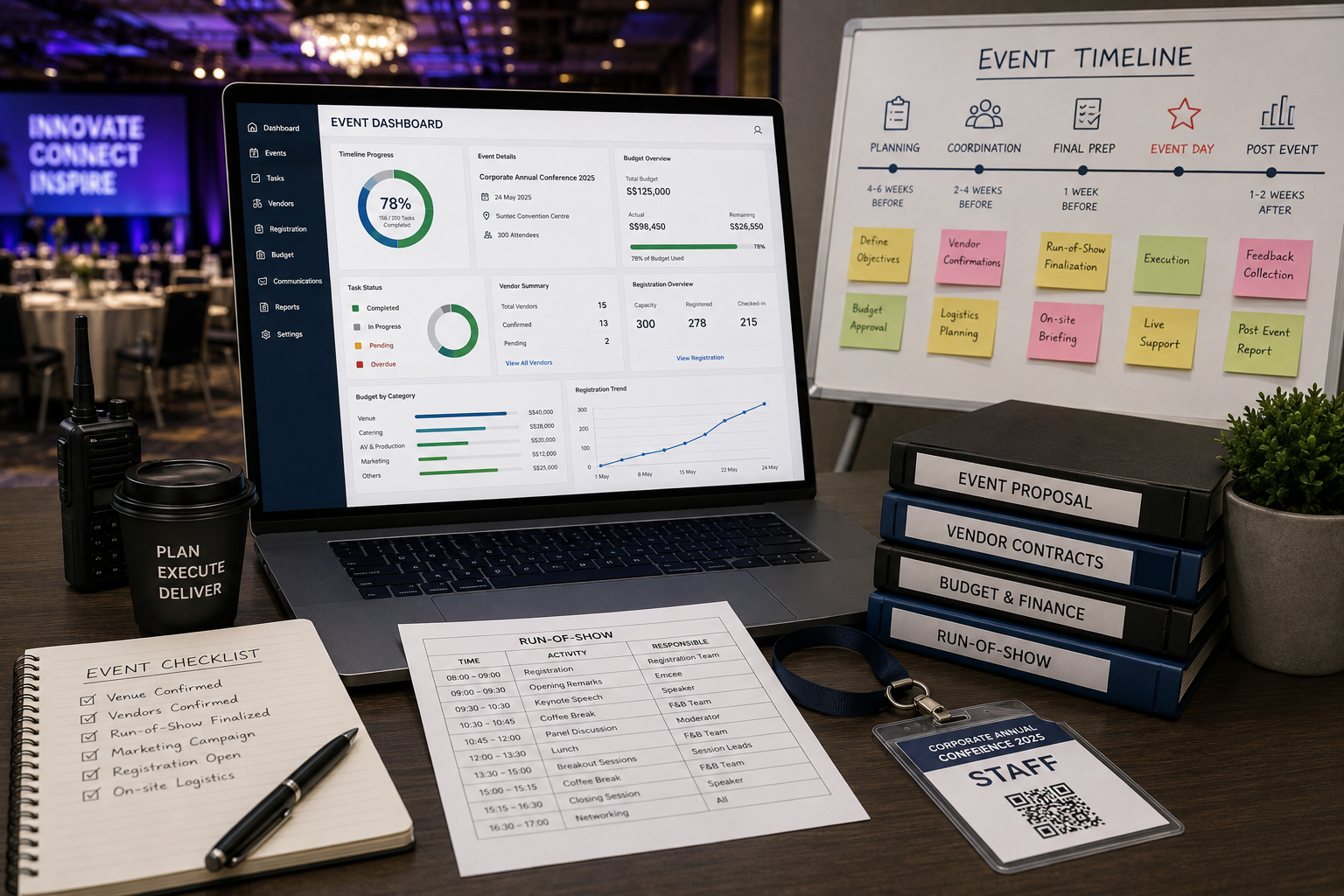
An event company in Singapore needs software that closes four gaps a shared Google Sheet and email chain cannot: project management that tracks 200 interdependent tasks against a hard deadline, vendor coordination that ties every supplier commitment to the event timeline, registration and ticketing that never oversells, and budget tracking that shows real profitability before the event closes, not after. A single corporate conference can involve 15 vendors, 300 attendees, 40 budget line items, and 200 tasks with dependencies between them – and a spreadsheet has no way to enforce any of the relationships between those four numbers.
Singapore’s event industry – corporate events, MICE, weddings, exhibitions, and public events – is project-based, deadline-driven, and vendor-intensive by nature. Managing that through spreadsheets and email works fine for months, then reliably stops working in the week before an event, exactly when the cost of a dropped task is highest. Below is what each core capability actually needs to do, and where a purpose-built venue and event platform closes the specific gaps a spreadsheet leaves open.
Why Do Event Companies Outgrow Spreadsheets Faster Than Other Businesses?
Because an event has a fixed, non-negotiable deadline and a spreadsheet has no concept of one. Most businesses can absorb a missed update or a late reconciliation and catch up later. An event can’t – the date doesn’t move, so every dependency (the caterer confirming headcount, the AV vendor confirming setup time, the venue confirming the hold) has to resolve correctly and on schedule, or the event itself is at risk. A shared sheet and an email chain can describe those dependencies but can’t enforce them, which is exactly why the failure shows up predictably in the final week rather than gradually over time.
Core Features for Event Businesses
Event Project Management
The problem: Each event is a project with a timeline, task owners, dependencies, and a hard deadline. Generic project tools don’t understand event-specific structures – run-of-show, setup days, rehearsal periods, and post-event breakdown – so teams end up rebuilding the same task structure by hand for every event.
What the software needs to do: Generate task lists from event templates, assign owners, track completion, and flag tasks at risk of missing their deadline automatically – understanding run-of-show and setup and breakdown periods as structural parts of the event, not generic to-do items.
Vendor and Supplier Management
The problem: AV suppliers, caterers, florists, photographers, venue managers, security – each vendor carries a quote, a confirmation, a delivery obligation, and an invoice. Tracked separately, nobody has one place to see whether every vendor commitment is actually on track against the event date.
What the software needs to do: Track every supplier commitment against the event timeline, with payment schedule visibility so finance knows exactly when each vendor payment is due, not discovered from a chased email.
Client and Attendee Communication
The problem: Corporate clients expect regular updates. Attendees need registration confirmations, venue information, and schedule changes communicated promptly. Handled manually, this is one of the largest hidden time costs for event coordinators.
What the software needs to do: Automate confirmation emails and bulk messaging, and give clients a portal for status visibility – removing the manual email workload that otherwise consumes a coordinator’s week.
Registration and Ticketing
The problem: Online registration needs to handle payment processing, dietary preference collection, badge generation, and door check-in – and for ticketed public events, overselling a venue’s capacity is a costly, visible failure.
What the software needs to do: Provide QR-code check-in, real-time capacity tracking, and waitlist management as standard, so overselling and door-management chaos aren’t possible by default.
Budget Management and Profitability
The problem: Event budgets start as estimates and evolve as vendor quotes come in. Without real-time tracking, an event can look profitable on paper until service charge, tax, and vendor costs are actually reconciled, often after the event has already happened.
What the software needs to do: Track actuals against estimates in real time, flag overruns before they become unrecoverable, and generate profit and loss by event – so which event types and clients are actually profitable is a known number, not a guess.
MICE and Government Events
The problem: Singapore is a major MICE destination, and events for government agencies and large corporates carry additional requirements – vendor accreditation, venue security clearance, post-event reporting, and audit-ready financial documentation.
What the software needs to do: Handle document management and approval workflows as a structural feature, so these requirements are met without becoming a separate administrative project layered on top of the event itself.
Integration with Accounting
The problem: Event revenues and costs need to flow into accounting accurately. Manually re-entering client invoices and vendor payments between the event platform and the accounting system is exactly where errors and reporting delays come from.
What the software needs to do: Generate client invoices directly from the event budget, reconcile vendor payments against purchase orders, and produce post-event P&L by client automatically, eliminating the manual re-entry step entirely.
How Moxogo Structures This as One Connected Event Record
The core problem every one of these features is solving – sales, coordination, and finance rebuilding the same event details in separate files – is exactly what Moxogo’s Event & Venue Management solution is built around: booking, costing, contracts, purchasing, invoicing, and reporting connected to a single live event record instead of six disconnected ones.
Booking conflicts are prevented structurally, not by manual checking: hard and soft holds block confirmed events from colliding, and cleanup buffers between bookings are enforced on the same live calendar, the exact double-booking failure mode that a shared calendar and manual checks can’t reliably catch. Every event runs on a cost sheet that calculates service charge, tax, event cost, and gross margin automatically, so profitability is visible before the event happens rather than reconciled afterward, closing the same budget-looks-fine-until-costs-come-in gap described above. Contracts generate directly from the event data with built-in approval checkpoints, and BEOs (banquet event orders) issue from the same live record with timings, venue, pax, and setup details already populated, so operations isn’t rebuilding what sales already captured.
This runs on the same core modules used across Moxogo’s platform: CRM keeps every enquiry and customer history tied to the booking so sales and coordination share full context from first contact; Sales Management builds quotations, packages, and approval flows that move an event from enquiry to confirmation; Purchase Management coordinates vendor commitments and procurement approvals tied back to the specific booking; Invoicing Management tracks deposits, progressive billing, and balance payments against every confirmed event; and Productivity Booster keeps sales, coordinators, approvers, and finance aligned on tasks and reminders without a separate project tool. Role-based access keeps cost and margin data visible only to approvers and finance, while coordinators work from the same event record without seeing figures that aren’t theirs to manage.
One Singapore venue operator running weddings, corporate functions, and social events across multiple spaces reported a 40% reduction in admin rework and 25% faster management reporting after moving off shared calendars and disconnected spreadsheets onto this structure, with eliminating confirmed booking clashes as the explicit target of the rollout.
What Mxgsoft Can Do for Event Businesses
We implement business systems for event management and MICE companies in Singapore, built on Moxogo’s Event & Venue Management platform. Our approach starts with the event delivery workflow, from brief to debrief, and extends into financial management and client reporting. Talk to us about what integrated event management looks like for your event volume and type mix.
Frequently Asked Questions
Why do event companies hit a wall with spreadsheets faster than other businesses? Because an event has a fixed deadline that doesn’t move, so every vendor confirmation, task dependency, and budget line has to resolve correctly and on time. A spreadsheet can describe those dependencies but can’t enforce them, which is why the failure shows up predictably in the final week before an event.
How does event software actually prevent double-booking a venue? Through hard and soft holds enforced on a single live calendar, with cleanup buffers built in between bookings, structural rules a shared calendar with manual checks can’t reliably enforce, since two people can confirm the same slot before either checks with the other.
Can event profitability really be known before the event happens? Yes, if the cost sheet calculates service charge, tax, event cost, and gross margin as vendor quotes and bookings are entered, rather than reconciling everything manually after the event closes.
What is the difference between a contract and a BEO in this workflow? The contract is the commercial agreement generated from event data and routed through approval. The BEO (banquet event order) is the operational document, timings, venue, pax, setup details, generated from the same live event record so operations isn’t re-keying what sales already captured.
Does this handle the extra requirements for MICE or government events? Yes, when document management and approval workflows are built into the platform structurally, covering vendor accreditation, security clearance documentation, and audit-ready financial records without adding a separate administrative process on top of the event.
Next step: Talk to us about what integrated event management looks like for your event volume and type mix, starting with the brief-to-debrief workflow and Moxogo Event & Venue Management as the platform underneath it.
More Articles

The Resource Master Audit: Why ERP Rollouts Fail at the Data Layer, Not the Software Layer
Most ERP go-lives don’t fail on features. They fail on messy master data. Here’s the Resource Master Audit that prevents it.
Read Article
The Compounding Moat: How Operational Discipline Becomes a Brand Competitors Can’t Copy
Taglines get copied overnight. Clean operational data doesn’t. How operational discipline becomes an unassailable competitive moat for SMEs. ...
Read Article
Engine and Brakes: What the Global AI Safety Debate Means for Your Business
A recurring metaphor in the global AI safety conversation, a powerful engine paired with good brakes, turns out to describe SME AI adoption just as we...
Read Article