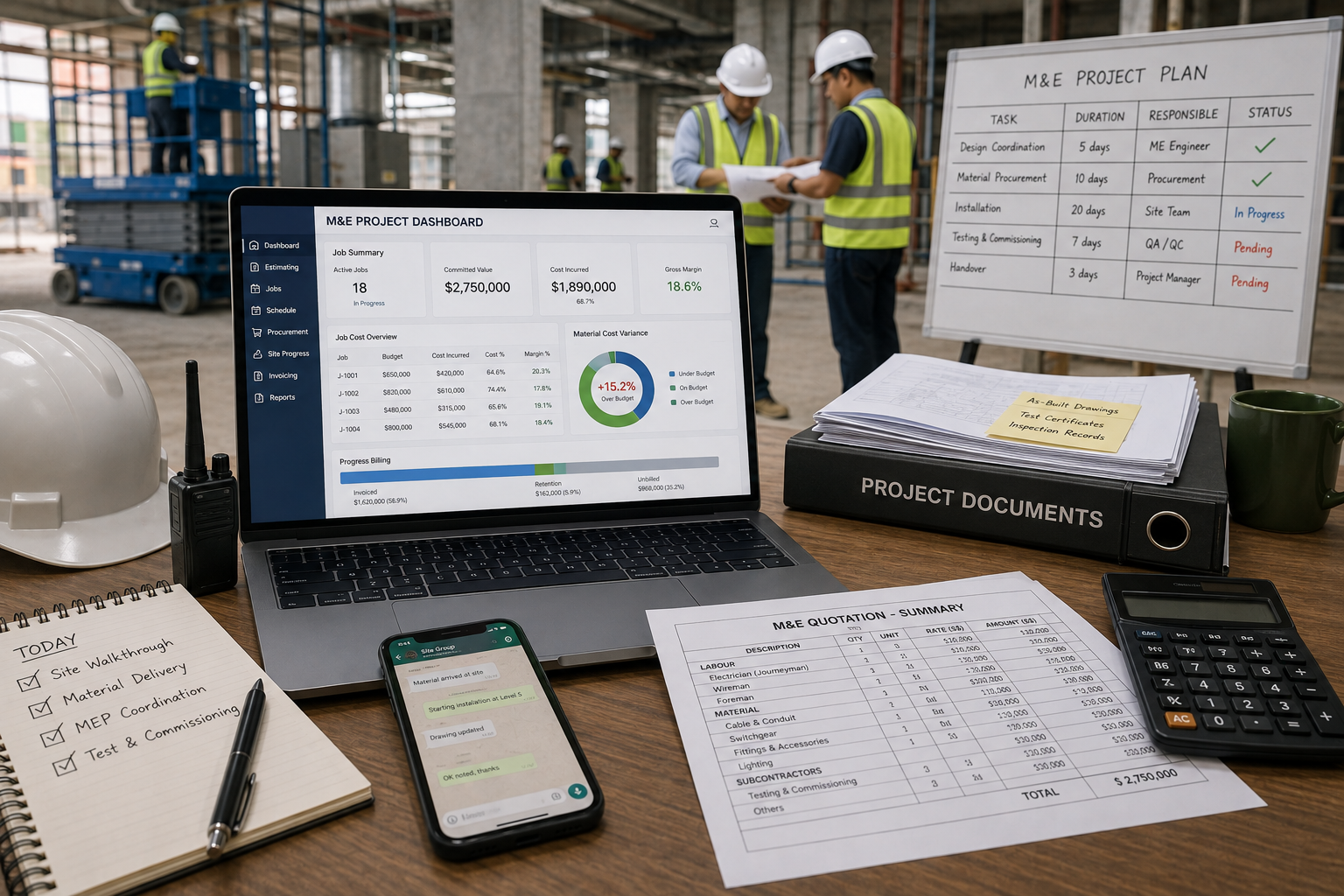
Why Do M&E Contractors in Singapore Need More Than WhatsApp, Email, and Excel?
An M&E contractor in Singapore needs software that closes four gaps generic tools leave open: estimating that prices labour, materials, and subcontractor costs accurately in hours rather than days; scheduling that accounts for EMA licence classes and site commitments; material tracking that flags cost overruns mid-job instead of at close-out; and progress billing that doesn’t lag weeks behind completed work. When jobs are run through a mix of WhatsApp, email, and Excel instead, none of these four things has a single source of truth — and margin leaks out through all of them at once.
Singapore’s electrical and mechanical contractors — from small electrical firms handling HDB rewiring to mid-size mechanical contractors managing building services projects — share the same operational pattern: quotes that take too long, schedules that slip, material costs that exceed estimates, and billing that trails project completion. Below is what each core capability actually needs to do, and where it connects to the wider job costing problem underneath all of them.
Why Do WhatsApp, Email, and Excel Fail M&E Contractors?
Because none of the three was built to be a system of record, and a contractor needs one. A quote sent by email, a schedule change confirmed over WhatsApp, and a material list tracked in a spreadsheet are three disconnected records of the same job. Nobody can look at one place and see what’s been quoted, what’s been ordered, what’s been installed, and what’s been billed — so each of those four things drifts independently until someone notices the gap, usually at the point it’s already cost money.
Core Capabilities for M&E Contractors
Estimating and Quotation
The problem: Accurate M&E estimating means pricing labour (journeyman rates, foreman rates, overtime), materials (cable, conduit, switchgear, fittings — all against current supplier prices), and subcontractor costs together. Built manually, a quote takes days, and there’s no record afterward to check whether the estimate was actually accurate against what the job cost.
What the software needs to do: Estimating with a live materials database generates quotes in hours rather than days, and stores every quote so win rates and margin accuracy can be analysed after the fact — turning estimating into a discipline you improve over time, not a one-off guess per job.
Job and Project Scheduling
The problem: Scheduling electricians and mechanical fitters across multiple concurrent sites means accounting for their certifications, EMA licence classes, and actual availability. Without visibility into all three at once, you either over-promise on delivery timelines or leave qualified people idle.
What the software needs to do: Show what’s committed and what capacity actually exists, filtered by licence class and certification, so a delivery date is a real commitment rather than an optimistic guess.
Material Procurement and Tracking
The problem: Materials are the largest cost variable on most M&E jobs. Without a live link between the estimate, the purchase order, and site usage, a job’s material cost can run well above estimate before anyone notices.
What the software needs to do: Raise purchase orders directly from the job estimate, track them against supplier delivery, and reconcile against site usage in real time — so when a job’s material costs are running 15% above estimate at the halfway point, you know it before it becomes a margin problem, not after.
Progress Billing and Variation Orders
The problem: M&E projects bill in stages, typically tied to completion milestones or monthly progress claims. Variation orders that arise during construction need to be approved, priced, and billed separately from the original contract — and when that process isn’t formal, billing delays stretch out the receivables cycle.
What the software needs to do: Manage progress claims, variation order workflow, and retention release as one connected process, so a completed milestone or an approved variation converts into an invoice without someone having to remember to raise it.
BCA and Regulatory Compliance
The problem: Electrical work in Singapore requires EMA-licensed workers, and test certificates, as-built drawings, and inspection records need to be ready for LTA, BCA, or building management sign-off. A folder of paper certificates that gets misplaced between completion and handover turns a straightforward sign-off into a delay.
What the software needs to do: Store digital job documentation against the project and make it retrievable on demand, so handover isn’t blocked by a missing paper certificate that should have been filed months earlier.
Maintenance Contract Management
The problem: Many M&E contractors also run recurring maintenance contracts — annual electrical inspections, chiller servicing, generator maintenance — as a separate revenue stream that needs its own tracking against SLA commitments.
What the software needs to do: Handle contract management, scheduled work order generation, and SLA performance tracking as a standing system, not a side calendar someone maintains manually alongside project work.
How Moxogo Connects Quoting to Job Cost Control
The underlying problem for M&E contractors is the same one Moxogo’s Job Costing & Budgeting solution is built to solve — the page explicitly names construction, electrical, M&E, and facility management as its target contractor types, and the estimating-to-billing flow above maps directly onto it. A bid captured in CRM converts into an active job budget through Sales Management the moment it’s won, so the estimate that determined your quote becomes the budget you’re tracked against from day one — not a separate number nobody checks again.
From there, Purchase Management issues purchase orders against the job estimate and tracks them against vendor bills before an overrun happens, which is exactly the 15%-over-estimate-at-the-halfway-point scenario made visible in real time instead of at close-out. Inventory & Warehouse allocates material cost to the specific job and tracks consumption against planned quantities, and Invoicing Management monitors contract value, invoiced amounts, and outstanding dues so progress billing and variation orders don’t lag behind completed work. At the job level, this is the same Job Cost Sheet structure the platform uses across all contractor types: planned quantity, cost per unit, and actual purchase or vendor bill quantity sitting side by side, so a material or labour variance shows up on the specific line causing it — not just as a total at the end.
Moxogo’s published benchmark data across this contractor base shows a 10–20% reduction in project overruns from real-time cost control and a 5–10% improvement in gross margins from bidding off historical job cost data — the same estimating discipline that turns quote accuracy from a guess into something you can actually measure and improve.
What Mxgsoft Can Do for M&E Contractors
We implement project and operations software for M&E contractors in Singapore, built on Moxogo’s job costing platform. The starting point is always the quote-to-cash cycle — making sure every job is estimated accurately, billed completely, and collected on time. Talk to us about what integrated contractor software looks like for your project mix and team size.
Frequently Asked Questions
Why do M&E contractors need dedicated software instead of WhatsApp, email, and spreadsheets? Because none of those tools acts as a single source of truth. A quote, a schedule change, and a material list tracked separately drift independently, and nobody can see in one place what’s been quoted, ordered, installed, and billed until the gap has already cost money.
How much faster is estimating with a live materials database? Estimating software with a live materials database and current supplier prices typically generates quotes in hours rather than days, and stores every quote so win rates and margin accuracy can be tracked over time.
How does scheduling account for EMA licence classes? A proper scheduling tool filters electricians and mechanical fitters by certification and EMA licence class alongside availability, so a delivery commitment reflects who’s actually qualified and free to do the work, not just who’s nominally on the roster.
When should a material cost overrun actually get flagged? As close to real time as possible — ideally the moment purchase orders and site usage are reconciled against the estimate, so a job running 15% over material budget is visible at the halfway point rather than discovered at close-out.
Is job costing software for M&E contractors different from job costing for general construction? Not structurally — Moxogo’s Job Costing & Budgeting platform is built for construction, electrical, M&E, facility management, and professional services on the same underlying job cost sheet and progress billing structure, with the specific labour rates, licence classes, and materials configured per trade.
Next step: Talk to us about what integrated contractor software looks like for your project mix and team size — starting with the quote-to-cash cycle and Moxogo Job Costing & Budgeting as the platform underneath it.
More Articles

The Resource Master Audit: Why ERP Rollouts Fail at the Data Layer, Not the Software Layer
Most ERP go-lives don’t fail on features. They fail on messy master data. Here’s the Resource Master Audit that prevents it.
Read Article
The Compounding Moat: How Operational Discipline Becomes a Brand Competitors Can’t Copy
Taglines get copied overnight. Clean operational data doesn’t. How operational discipline becomes an unassailable competitive moat for SMEs. ...
Read Article
Engine and Brakes: What the Global AI Safety Debate Means for Your Business
A recurring metaphor in the global AI safety conversation, a powerful engine paired with good brakes, turns out to describe SME AI adoption just as we...
Read Article