What ERP Features Does a Building Materials Distributor in Singapore Actually Need?
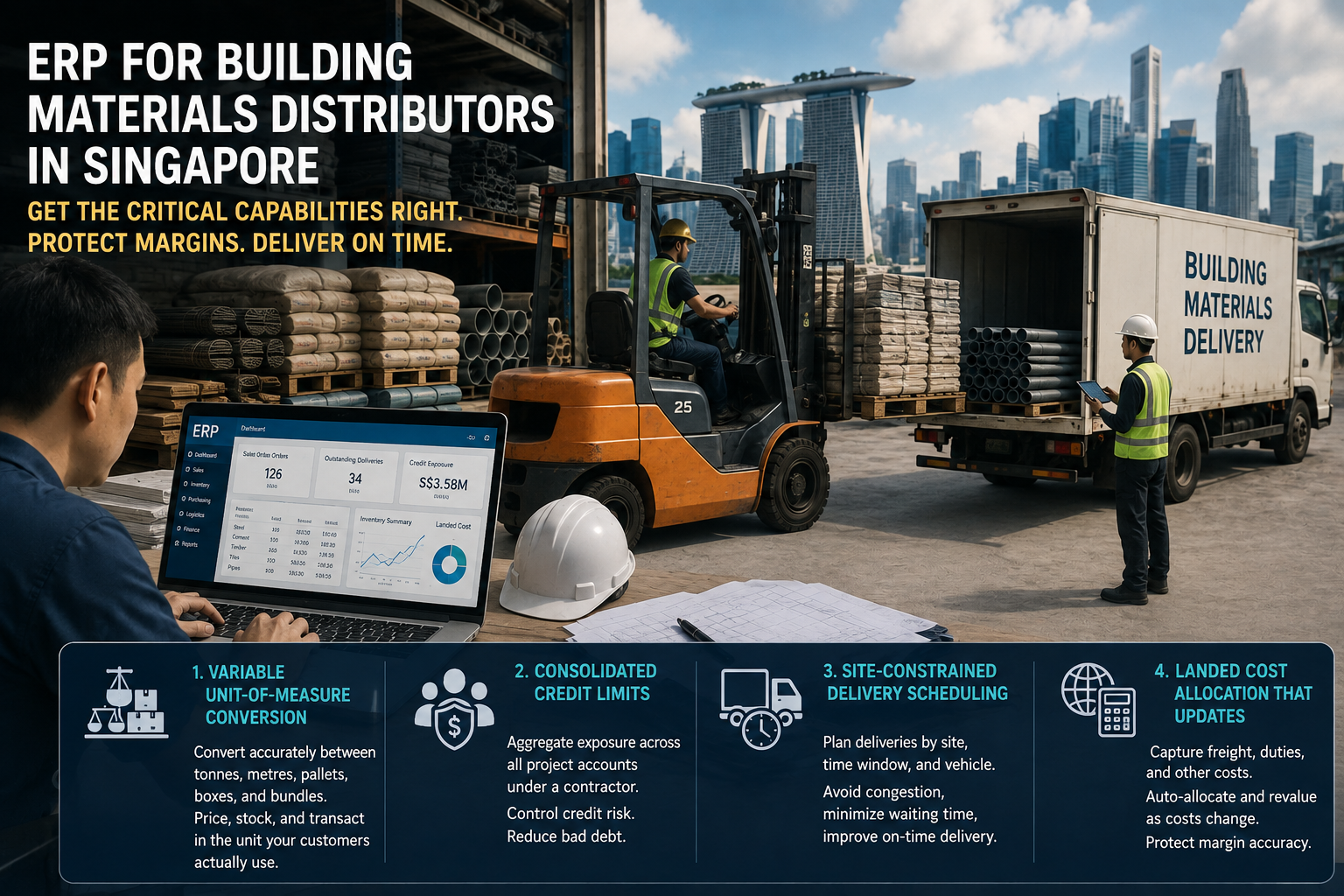
A building materials distributor in Singapore needs an ERP that handles four things generic systems get wrong: variable unit-of-measure conversion (tonnes to metres, pallets to boxes), consolidated credit limits across a contractor’s multiple project accounts, site-constrained delivery scheduling, and landed cost allocation that updates as freight and duties shift. Miss any one of these and the gap gets absorbed as margin leakage, bad debt, or wasted driver hours — not as a line item anyone notices until month-end.
Singapore’s construction sector runs on hard deadlines, 90-to-120-day credit terms, and commodity pricing that moves weekly. Managing steel, cement, timber, tiles, or MEP supplies isn’t a “buy-one, sell-one” retail problem — it’s a logistics and credit orchestration problem wearing an inventory system’s clothes. Below is what each of the four capabilities actually needs to do, and why off-the-shelf ERP typically fails at it.
Why Do Generic ERP Systems Struggle With Building Materials?
Generic ERP is built for single-unit, single-account, fixed-cost transactions — building materials distribution is none of those three. Steel arrives by tonne, gets stored in bundles, and sells by length. A contractor’s five live projects need five delivery addresses but one enforced credit ceiling. Import freight changes the true cost of stock weekly. Most ERP platforms handle one of these reasonably and quietly break on the other two, which is why so many distributors are still running the exceptions through spreadsheets next to a “modern” system.
1. Variable Unit-of-Measure (UOM) Precision
The problem: Steel is bought by tonne, stored as bundles, and quoted by length. Tiles arrive on pallets but sell by the box or square metre. Timber is purchased by cubic metre and sold by board foot or linear metre. Every manual conversion between these is a place where a stock-take discrepancy or an invoicing error can hide.
What the ERP needs to do: Run a dual-UOM matrix — tracking real-time inventory in standard stock-keeping units while transacting in whatever unit the sale actually uses. Done correctly, this removes rounding errors and the “phantom stock” that shows up when purchase units and sales units have been reconciled by hand for years.
2. Consolidated Credit Enforcement Across Project Sub-Accounts
The problem: A main contractor opens five separate project accounts. They max out credit on Project A, then quietly place new orders under Project B — and unless someone is manually cross-checking accounts, nobody catches it until the debt is already unrecoverable.
What the ERP needs to do: A parent-child account structure where credit limits are enforced at the parent level, aggregating exposure across every child project in real time. If the parent entity is overdue or over its limit, new sales orders get a hard hold across all its sub-accounts automatically — not on a Monday-morning credit review three weeks later.
3. Site-Constrained Delivery Scheduling
The problem: Construction sites don’t take deliveries whenever it’s convenient for the supplier. A congested site without crane availability, or one that only accepts deliveries in an early-morning window before other trades arrive, will reject a load that misses the slot — and that’s wasted driver hours and double-handling, not just an annoyance.
What the ERP needs to do: Delivery scheduling tied to each site’s actual access constraints, with route-optimised dispatching and automated alerts to site supervisors ahead of arrival. The goal isn’t just “the truck showed up” — it’s “the truck showed up in the fifteen-minute window the site can actually use.”
4. Dynamic Landed Costing and Margin Guardrails
The problem: Import freight, port tariffs, and currency movement change the real cost of imported materials weekly. A quote built on a static cost database is a quote built on last month’s numbers — and the gap comes straight out of gross margin.
What the ERP needs to do: Automatic landed cost allocation — freight, duty, insurance, clearance — pushed into real-time inventory valuation, with minimum-margin checks enforced at the point of sales order entry, not discovered during month-end reconciliation.
How Mxgsoft Approaches This
A polished front-end sitting on an unintegrated backend doesn’t solve any of the four problems above — it just makes them harder to see. Mxgsoft implements Odoo-based distribution architectures built specifically for Singapore’s trade ecosystem, including native InvoiceNow (Peppol / PINT-SG) compliance for enterprise billing.
We structure this work around what we call the V.A.L.U.E. framework:
- Volume — automate quote-to-delivery conversion across thousands of active SKUs
- Accuracy — remove manual UOM math and the inventory variance it creates at month-end
- Leverage — let a lean operations team run dozens of active job sites without operational drag
- Urgency — close credit leaks before they become bad debt
- Expansion — build an API-first backbone ready to connect to customer procurement portals
Frequently Asked Questions
What ERP features matter most for a building materials distributor? Variable unit-of-measure conversion, consolidated credit limits across a customer’s project accounts, site-constrained delivery scheduling, and dynamic landed costing. These four cover where generic ERP most commonly breaks down for materials distributors.
Why do generic ERP systems fail for building materials distribution? They’re designed around simple, single-unit, single-account transactions. Building materials distribution runs on non-linear UOM conversions, multi-project credit exposure, and shifting landed costs — all of which need purpose-built handling, not workarounds.
How does ERP prevent a contractor from exceeding credit limits across projects? By enforcing credit limits at the parent account level across all of a contractor’s project sub-accounts in real time, so an overdue or over-limit parent triggers an automatic hold on new orders anywhere under it — not just on the specific project account that’s over.
Can ERP handle steel sold by length but stored by tonne? Yes, with a dual-UOM matrix that tracks stock in standard stock-keeping units while transacting in the unit the sale actually uses, converting automatically instead of relying on manual calculation.
Does landed cost update automatically when freight or duties change? In a properly configured system, yes — landed cost allocation (freight, duty, insurance, clearance) feeds directly into inventory valuation, so margin checks at the point of sale reflect current costs rather than a static cost database.
Next step: Run a 30-minute audit of your current SKU mapping and credit-holding workflows. We’ll identify where your system is leaking margin today and map out a lean Odoo migration roadmap — contact the Mxgsoft team to get started.
More Articles

The Resource Master Audit: Why ERP Rollouts Fail at the Data Layer, Not the Software Layer
Most ERP go-lives don’t fail on features. They fail on messy master data. Here’s the Resource Master Audit that prevents it.
Read Article
The Compounding Moat: How Operational Discipline Becomes a Brand Competitors Can’t Copy
Taglines get copied overnight. Clean operational data doesn’t. How operational discipline becomes an unassailable competitive moat for SMEs. ...
Read Article
Engine and Brakes: What the Global AI Safety Debate Means for Your Business
A recurring metaphor in the global AI safety conversation, a powerful engine paired with good brakes, turns out to describe SME AI adoption just as we...
Read Article