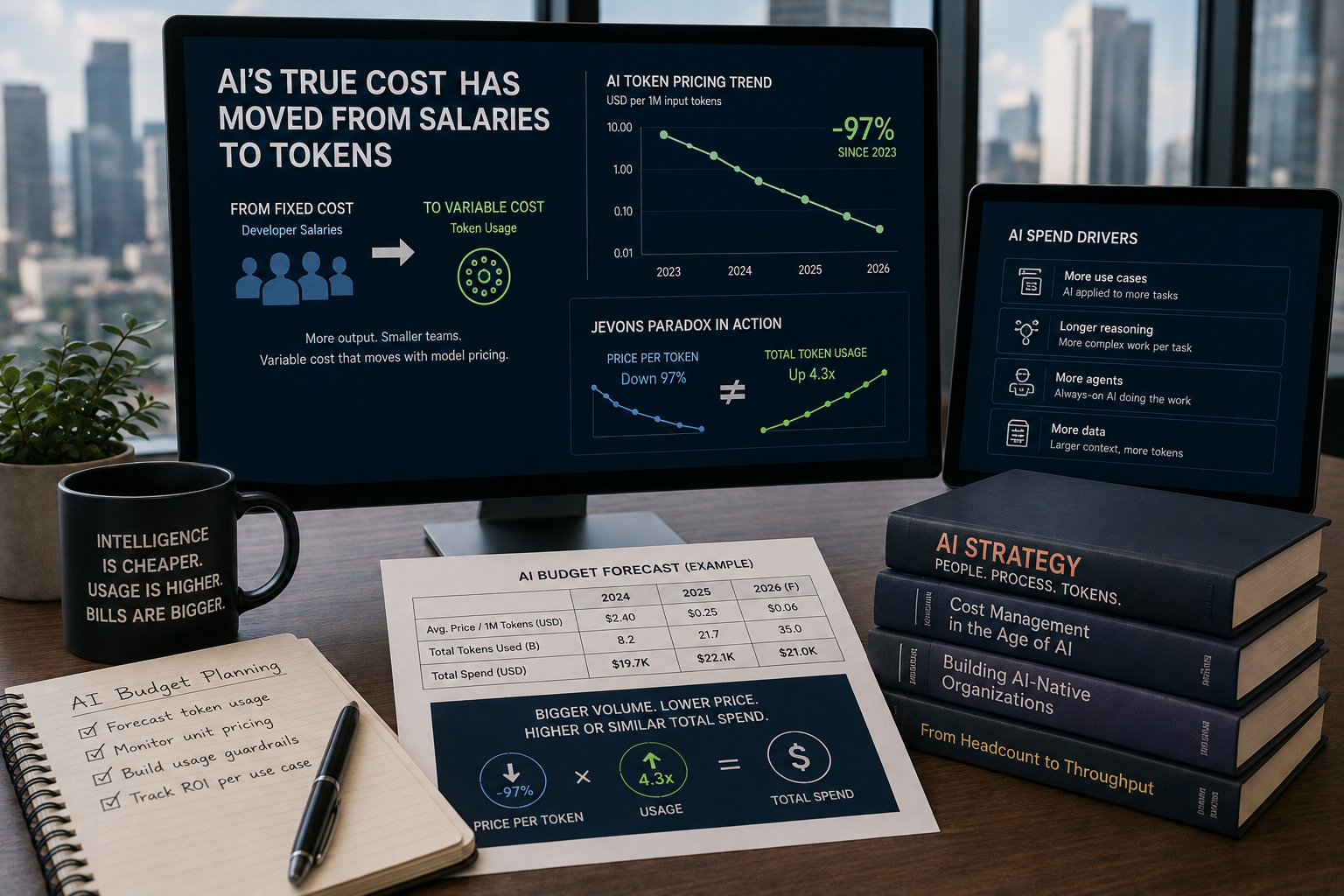
Why Has the True Cost of AI Shifted from Headcount to Tokens?
AI’s true cost has quietly moved from a fixed number on an org chart to a variable number on a usage bill. For sixty years, computing cost was denominated in developer hours: hire people, pay salaries, ship code. Today, a growing share of software work is denominated in tokens – the units of text an AI model reads and writes to do the work. That shift changes how businesses should budget for AI, how they should think about hiring, and how exposed they are to a supplier simply changing its price overnight.
None of this is theoretical. It’s visible in how fast AI company revenues are moving, in how AI vendors are restructuring their own pricing, and in which kinds of professional skill are holding value versus losing it. Here’s what’s actually changed, what’s happened in 2026 specifically, and what it means if you’re running a business in Singapore rather than a frontier AI lab in San Francisco.
Why Has AI’s Real Cost Moved from Salaries to Tokens?
Because increasingly, you’re not paying someone to follow instructions – you’re paying a model to reason its way to an outcome, and that reasoning is metered by the token. Traditional software cost scaled with headcount: more code needed, more developers hired. AI-native work scales with consumption: more tokens processed, more output produced, at a price set by whichever model is doing the reasoning. A small team using AI agents extensively can now produce output that used to require a much larger team – but their variable cost is a usage bill that moves with model pricing, not a fixed payroll that moves with headcount decisions you control.
The Economics Nobody Budgets For: Cheaper Tokens, Bigger Bills
The price of a unit of AI intelligence has been falling sharply and repeatedly – each new model generation from every major lab tends to deliver comparable or better capability at a fraction of the previous generation’s price. The intuitive assumption is that falling unit prices should shrink AI budgets. In practice, the opposite happens, and there’s a name for why: Jevons Paradox. When a resource gets cheaper, people don’t use less of it – they find more uses for it and consume more in total. Cheaper steam power didn’t reduce coal consumption; it multiplied it by making more applications of steam power economical. Cheaper cloud computing didn’t shrink IT budgets; it expanded what teams built. Falling token prices are following the identical pattern: as intelligence gets cheaper per unit, businesses run more of it – longer reasoning chains, more autonomous agents, more tasks handed off entirely – and total AI spend keeps climbing even as the per-unit price falls.
That’s the trap in AI budgeting: a falling price per token is not the same thing as a falling AI bill. If usage grows faster than the price falls – which is exactly what’s happening across the industry – total spend rises even while every individual unit gets cheaper.
What Actually Happened in 2026
The scale of this shift shows up clearly in how fast AI-native revenue is moving. Anthropic’s own disclosed run-rate revenue went from roughly $9 billion at the end of 2025 to an estimated $47 billion by mid-2026 – a trajectory steep enough that the company confidentially filed for an IPO in June 2026 at a reported $965 billion valuation, following a $65 billion funding round. A large share of that growth is coming from consumption-priced products rather than traditional per-seat software: Claude Code, Anthropic’s coding tool priced almost entirely by usage rather than by seat, reportedly went from zero to a $2.5 billion annualised run-rate in about nine months – a growth curve that a flat per-seat SaaS product essentially cannot produce, because consumption-based pricing captures value every time a system runs, not just when a new seat is added.
The same shift is creating real pricing risk downstream. Several AI coding tools that originally sold flat-rate, unlimited-usage subscriptions found those plans becoming uneconomical once the underlying model providers own pricing and usage patterns shifted, forcing public restructuring into usage-based or higher-priced tiers within the space of a single year. For any business buying AI tools rather than building them, that’s the practical lesson: a vendor’s price today reflects their current cost structure, and that structure can move faster than your budget cycle does.
What This Means for Professional Skill and Hiring
The clearest shift in developer and knowledge-worker value isn’t about AI replacing people outright – it’s about which kind of value is commoditizing and which kind isn’t. Producing generic, undifferentiated output – code, copy, analysis that any well-prompted model can generate about equally well – is getting cheaper at the same rate tokens are getting cheaper, because that’s exactly the work tokens are best at replacing. What isn’t commoditizing is judgment: knowing which problem is actually worth solving in a specific market, knowing what good looks like for a specific client or industry, and knowing how to direct AI systems toward outcomes that matter rather than outputs that merely look complete.
In practice, this rewards depth over generality. A generalist producing competent, average work in a crowded category is competing directly against a model that can produce the same average work near-instantly and near-free. A specialist who combines real domain knowledge – how a specific industry actually operates, what its compliance requirements are, what its customers actually need – with enough AI fluency to direct a model toward that specific problem is doing something a generic model alone cannot: supplying the judgment about where to point the intelligence in the first place. That combination is becoming more valuable precisely because the intelligence itself is getting cheaper and more abundant.
What It Means for Singapore SMEs Specifically
For an SME evaluating AI-powered systems – whether that’s an AI-assisted ERP, an automation layer, or a custom agent built for a specific workflow – three practical implications follow directly from the economics above.
Budget AI spend as a variable operating cost, not a fixed subscription line. If a vendor’s pricing is usage-based, directly or indirectly through the models it’s built on, the bill will move with how much the system is actually used – which is usually a sign the system is working, not a sign something’s wrong, but it needs to be planned for rather than discovered on an invoice.
Ask what happens if the underlying model pricing changes. Any AI tool a business depends on is itself a customer of a model provider. A pricing change upstream can force a vendor to restructure overnight, as happened publicly to more than one AI coding tool in the past year. Understanding whether a vendor absorbs that risk or passes it straight through is worth asking before building a workflow around them.
The advantage available to a small, focused business hasn’t disappeared – it’s shifted. A large enterprise can out-spend almost anyone on raw compute. It generally cannot out-know a specialist operating in a specific Singapore industry, with real client relationships and real domain context, about where to point a modest AI budget at exactly the right problem. That’s still a genuine, durable advantage, and if anything it’s getting stronger as intelligence itself becomes a commodity everyone can buy.
Frequently Asked Questions
If AI is getting cheaper, why are AI companies costs and revenues both exploding? Because cheaper intelligence gets used more, not less – the same pattern (Jevons Paradox) seen historically with steam power and cloud computing. Falling per-token prices are being offset, and then some, by dramatically higher token consumption per task and across more tasks.
Does this mean AI will replace software developers? Not uniformly. The work most exposed is generic, undifferentiated output that a well-prompted model can already produce about as well as an average developer. Work that combines deep domain expertise with the judgment to direct AI systems toward the right problem is holding, and in some cases gaining, value.
What is the practical risk for a business buying AI-powered software rather than building it? Pricing risk passed through from the underlying model provider. If a vendor’s own costs are usage-based, a pricing change from their model supplier can force a sudden restructuring of what customers pay – something that has already happened publicly to more than one popular AI tool within the past year.
Should an SME wait for AI costs to fall further before adopting it? Not necessarily – falling unit prices historically expand what’s economical to automate rather than simply making today’s use cases cheaper later. The businesses gaining ground are the ones learning to direct AI at the right problems now, not the ones waiting for a lower price that arrives alongside dramatically higher expectations of what AI should be doing.
How should a business budget for AI if usage is unpredictable? Treat it as a variable operating cost tied to actual usage rather than a fixed subscription, monitor it the way a utility bill would be monitored, and ask any vendor directly how their own pricing would change if their underlying model costs changed.
Willie is the Managing Director of Mxgsoft Pte Ltd, a Singapore-based digital transformation company specialising in ERP implementations, workflow automation, and AI-powered business solutions. This article explores the strategic implications of AI’s shifting cost model for developers, enterprises, and SMEs across Southeast Asia and beyond.
More Articles
The Resource Master Audit: Why ERP Rollouts Fail at the Data Layer, Not the Software Layer
Most ERP go-lives don’t fail on features. They fail on messy master data. Here’s the Resource Master Audit that prevents it.
Read Article
The Compounding Moat: How Operational Discipline Becomes a Brand Competitors Can’t Copy
Taglines get copied overnight. Clean operational data doesn’t. How operational discipline becomes an unassailable competitive moat for SMEs. ...
Read Article
Engine and Brakes: What the Global AI Safety Debate Means for Your Business
A recurring metaphor in the global AI safety conversation, a powerful engine paired with good brakes, turns out to describe SME AI adoption just as we...
Read Article