The EDGE Grant Is Here: What Replaces EDG, PSG, and MRA from 30 September 2026
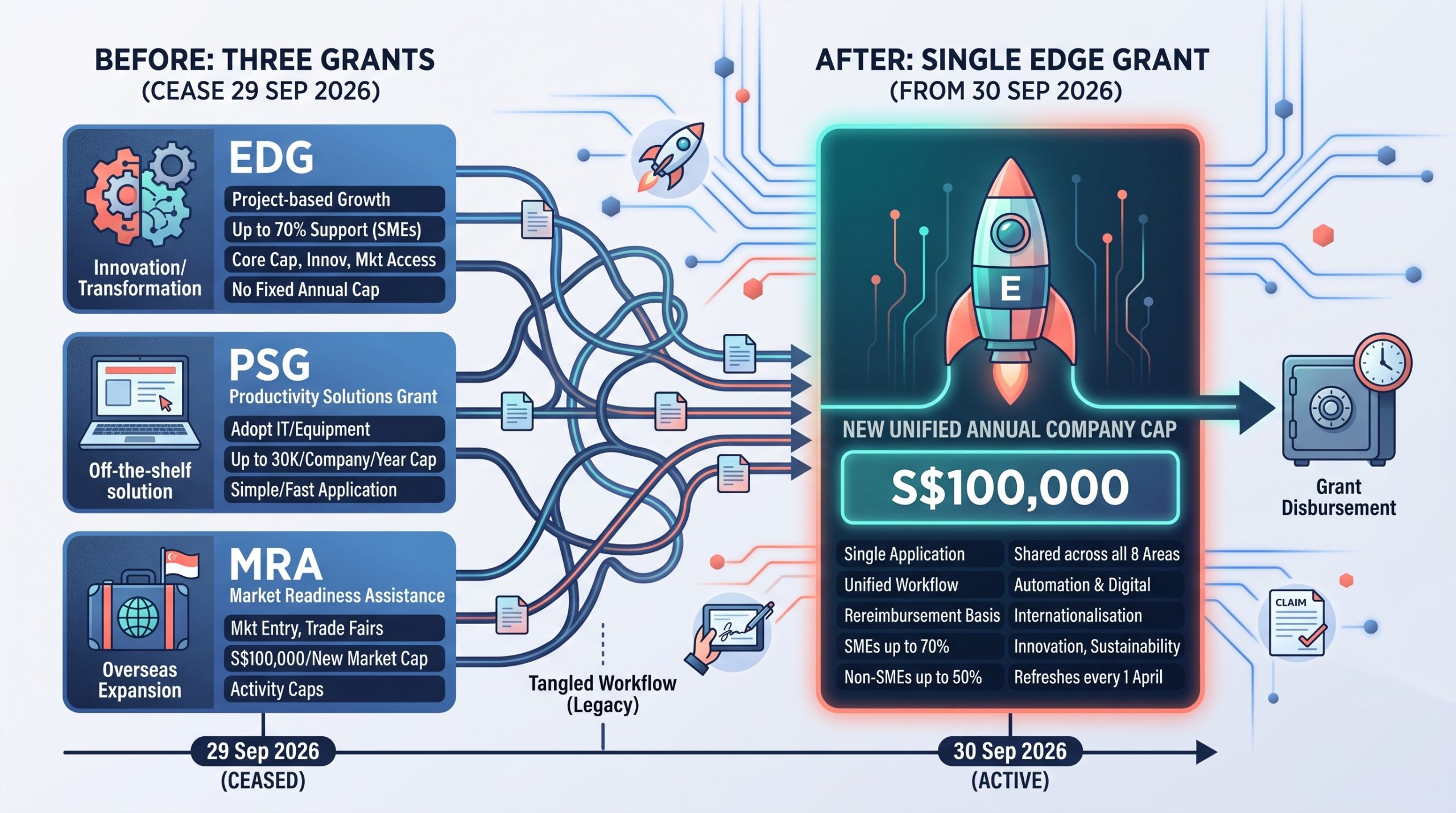
From 30 September 2026, Enterprise Singapore’s new EDGE Grant replaces three separate schemes, the Enterprise Development Grant (EDG), Productivity Solutions Grant (PSG), and Market Readiness Assistance (MRA), with a single application covering more than 150 activities across eight business areas. EDG, PSG, and MRA stop accepting new applications after 29 September 2026. EDGE launches alongside BizSG, a new government portal with an AI-powered grant recommender. If your business has used any of these grants before, or is planning a digitalisation, automation, or overseas expansion project this year, here is what actually changes, including a cap detail that matters a lot more for ERP and automation projects than the headline S$100,000 figure suggests.
What Exactly Changes on 29-30 September 2026?
According to Enterprise Singapore’s official EDGE Grant FAQ, EDG, MRA, and PSG remain accessible right up until EDGE launches, and stop accepting new applications after 29 September 2026. If you have an ongoing EDG, MRA, or PSG submission or project, it continues to be assessed and supported under the original scheme’s requirements, through to project completion and claim disbursement. Businesses that previously applied for or received funding under EDG, MRA, or PSG can still apply for EDGE afterwards; there is no exclusion for repeat applicants.
One separate deadline worth flagging if your grant is linked to SkillsFuture Enterprise Credit (SFEC): employers must submit final claims for SFEC-supported programmes under EDG, MRA, or PSG by 30 November 2026. EDGE itself will not be supportable under SFEC, so this closes a funding stacking option that won’t carry over to the new scheme.
A Quick Recap: What Were EDG, PSG, and MRA?
If you have not dealt with Singapore grants before, the three legacy schemes covered different needs:
- EDG (Enterprise Development Grant): project-based funding for growth and transformation work, covering three pillars: Core Capabilities, Innovation and Productivity, and Market Access. Standard support was up to 50% of qualifying costs for SMEs (30% for non-SMEs), rising to 70% for sustainability-linked projects. There was no fixed annual company cap; support was calculated as a percentage of each approved project’s cost.
- PSG (Productivity Solutions Grant): funding for adopting pre-approved, off-the-shelf IT solutions and equipment. Simpler and faster to apply for than EDG, but capped at S$30,000 per company per year.
- MRA (Market Readiness Assistance): support for overseas expansion activities like market entry studies, business matching, and trade fairs, capped at differing amounts per activity, with an overall S$100,000 cap per company per new market.
A business pursuing an ERP rollout while also entering a new export market might previously have needed to apply to EDG and MRA separately, each with its own eligibility rules, forms, and assessment criteria.
BizSG: The New Front Door for Government Business Support
EDGE does not launch on its own. On 30 September 2026, the Ministry of Trade and Industry and Enterprise Singapore are also launching BizSG, a whole-of-government portal at bizsg.gov.sg meant to be a single entry point for government business support, starting with grants and internationalisation resources. Businesses that log in with CorpPass get personalised recommendations rather than having to work out which agency’s website covers what.
The feature most relevant here is the grant recommender: an AI-powered chat tool that asks about your business needs in natural language and surfaces matching EDGE (and select Skills and Workforce Development Agency) grant activities, alongside an eligibility pre-check based on your shareholding and employment size. In the official demo, a business describes wanting to “automate my kitchen operations,” and the recommender returns three matching EDGE automation activities with their equipment requirements, funding tiers, and eligibility pre-check results, plus a reminder of two conditions that apply across the board: no prior commitments (no work started, no payment made, no deposit placed with a vendor before applying) and a 12-month completion window from approval. Enterprise Singapore’s own interface carries a visible disclaimer on this tool: AI can make mistakes, and grant approval always depends on the assessing agency’s own review. That is a useful data point in itself, since it confirms directly from Enterprise Singapore that the recommender is a discovery aid, not the actual assessor.
BizSG also includes a tariff calculator (showing potential savings under relevant Free Trade Agreements), export trend data by product and market, and a curated database of overseas business contacts across 30 markets. The full range of government grants beyond EDGE and select SWDA schemes will be added progressively through 2027.
What EDGE Actually Offers
A few things worth clearing up first: EDGE is not an acronym. Enterprise Singapore’s own FAQ says the name simply conveys the intent, giving enterprises an edge over their competitors, so there is no expanded form to memorise. To qualify, the applicant must be a business entity registered in Singapore with at least 30% Singaporean and/or Singapore Permanent Resident ownership, with additional requirements possible depending on the specific activity.
On funding, the rate is not a flat 70%/50% split. Enterprise Singapore’s EDGE annex sets it out by activity type:
- Internationalisation and Sustainability activities: up to 70% for SMEs, up to 50% for non-SMEs.
- All other activities (including automation and digitalisation): up to 50% for SMEs, up to 30% for non-SMEs.
The overall structure:
- A total grant support cap of S$100,000 per company per year across all eligible activities combined, resetting every year.
- Within that S$100,000, up to S$30,000 can be used specifically on single-function digital solutions, integrated enterprise systems, and selected automation activities. This sub-cap is easy to miss and matters a great deal for anyone planning an ERP or automation project; more on that below.
- Grant support is disbursed on a reimbursement basis: you pay for the activity first, then claim once it is completed and fully paid.
- If no suitable activity exists under EDGE for a business’s needs, Enterprise Singapore’s stated fallback is a referral to SME Centres for business advice, toolkits, or other non-EDGE government support schemes, not a case-by-case exception to the cap itself. As of this writing, there is no published pathway to apply for support above the S$100,000 (or S$30,000 sub-cap) ceiling.
The Detail Most Coverage Skips: Two Caps, Not One
Most write-ups on EDGE frame it purely as a simplification win: one application instead of three, and a broader activity list. That is genuinely true. What gets far less attention is that EDGE introduces not one but two ceilings that did not exist together under the old schemes, and the smaller one lands squarely on the category of work most SMEs actually want grant support for: automation and digitalisation, the same territory previously covered under EDG’s Innovation and Productivity pillar and PSG’s pre-approved solutions.
EDG itself had no fixed annual cap tied to the scheme; support was calculated as a percentage of each approved project’s cost, so a large enough transformation project could in principle draw well above S$100,000 in a single year. PSG had its own separate S$30,000 annual cap, but that cap covered PSG’s specific pre-approved solution list, not a general “digital and automation” bucket sitting inside a larger pool. Under EDGE, digital solutions, integrated enterprise systems, and selected automation activities are capped at S$30,000 a year, inside the overall S$100,000 pool, meaning a business cannot simply redirect unused internationalisation or sustainability budget toward a bigger ERP or automation project. The S$30,000 ceiling holds regardless of how much headroom is left in the S$100,000 total.
None of this makes EDGE a bad scheme, and the simpler single application genuinely helps most SMEs running one moderate project a year. But if your business is planning anything beyond a modest digital or automation project, the honest comparison is not “EDGE’s S$100,000 versus EDG’s 50%,” it is “EDGE’s S$30,000 digital and automation sub-cap versus EDG’s uncapped, percentage-based support for the same category of work.”
How This Affects an ERP or Automation Project Specifically
An ERP implementation or upgrade is precisely what “integrated enterprise systems” describes, so it falls inside the S$30,000 sub-cap, not the full S$100,000 pool. At up to 50% support for an SME, S$30,000 in grant funding corresponds to a project cost of roughly S$60,000. A small, single-module rollout will likely fit comfortably within that. A typical mid-sized ERP implementation, and certainly a multi-phase or multi-module one, will often cost well beyond that S$60,000 mark, meaning the grant only covers a portion of the total cost rather than scaling with the project the way EDG’s percentage-based, uncapped-by-scheme funding did.
This is the single most consequential detail for anyone at Mxgsoft’s end of this: a mid-sized or larger MoxogoERP implementation that would have drawn meaningful EDG support based on project cost alone may draw substantially less under EDGE’s S$30,000 digital and automation ceiling, even though the headline S$100,000 annual cap sounds generous. If a client’s project genuinely needs more grant support than the S$30,000 sub-cap allows, and there is no published exception pathway, the practical options are to apply under EDG before the 29 September cutoff, to scope the project down to fit the sub-cap, or to plan on self-funding the gap.
Practical Application Mechanics Worth Knowing
A few operational details from Enterprise Singapore’s EDGE FAQ that affect how an application actually gets put together:
- Vendor choice depends on the activity. Some EDGE activities require selecting from a pre-approved vendor list (vendors already assessed for credibility); others allow you to engage any vendor of your choice. Confirm which applies before quoting a project.
- Changing vendors after submission is not straightforward. Once an EDGE application is submitted, change requests are only accepted for the project end date and the claim due date. Any other change, including a vendor swap, requires terminating the existing application on the Business Grants Portal and submitting a fresh one.
- No prior commitments, no exceptions. As with the legacy schemes, work cannot have started, no payment can have been made, and no deposit can have been placed with a vendor before the application is submitted.
- Processing time varies by activity and will be published on the EDGE website and BizSG from launch. Build in a buffer rather than assuming a fixed turnaround.
A Dated Action Checklist
Before 29 September 2026:
- If a project is already scoped and could plausibly need more than S$30,000 in grant support for digital, automation, or integrated system work this year, submit under EDG now rather than waiting for EDGE’s sub-cap. Nothing can have started, been paid for, or been contracted before the application goes in.
- Get the actual vendor quotation and project scope locked in first. An application filed just to beat the deadline, without a properly scoped project behind it, is more likely to stall in review than to sail through.
- If any of your active grants are linked to SkillsFuture Enterprise Credit, diarise the 30 November 2026 final claim deadline separately; it does not move with the EDGE launch date.
From 30 September 2026:
- New applications go through EDGE, most likely via the BizSG portal’s grant recommender. Use it to confirm which business area and funding tier a project falls under before submitting.
- Confirm early whether your planned vendor is on a pre-approved list for the relevant activity, since that affects both eligibility and how much flexibility you have if the vendor relationship changes later.
- Expect a wave of applications in the first few weeks as businesses that held off for the “simpler” scheme all submit around the same time. Build a longer processing buffer into your project timeline for anything filed in October.
Ongoing, regardless of the date:
- Existing approved EDG, PSG, or MRA projects are unaffected. They run to completion under their original terms, and claims are still payable after 30 September.
Deciding by Project Size, Not by Guesswork
The honest version of “apply now or wait” comes down to arithmetic, not urgency, and the arithmetic is now sharper than a single S$100,000 figure suggests:
- Small, single-activity project, well under S$30,000 in digital or automation support (or a larger internationalisation project well under S$100,000): there is little reason to rush. EDGE’s simpler single application, and the higher 70% SME rate for internationalisation and sustainability work specifically, will likely serve this kind of project fine.
- An ERP implementation, integrated system, or automation project likely to need more than roughly S$60,000 in project cost at SME support rates (S$30,000 in grant support): the numbers favour applying under EDG’s current, uncapped-by-scheme terms before 29 September, since there is no confirmed EDGE pathway to exceed the S$30,000 digital and automation sub-cap.
- A project stacking multiple activity types, for example digitalisation alongside overseas expansion, in the same year: check both the S$30,000 sub-cap and the overall S$100,000 pool against the specific mix of activities before deciding.
A Word on How Applications Actually Get Assessed
It is worth being direct about one thing: Enterprise Singapore assesses grant applications on project scope, deliverables, and the track record of the vendor or consultant involved, not on how many “AI” or “automation” keywords appear in the project description. Even Enterprise Singapore’s own BizSG grant recommender carries a visible disclaimer that the AI-generated suggestions can be wrong and that grant approval always depends on the assessing agency’s own review, not the tool’s output. A rushed application that inflates or misdescribes what a project actually does, in an attempt to get bumped into a higher evaluation bracket, is more likely to trigger clarification requests or get rejected outright than to succeed. Worse, since grant conditions allow Enterprise Singapore to audit claims and claw back funding where a project’s actual deliverables do not match what was approved, an inaccurate scope creates real downside for the business much later, well after the grant has been spent. The honest approach, describing exactly what the project does and why it qualifies, is also the faster one: a clear, accurately scoped application has less back-and-forth to work through.
Frequently Asked Questions
When does the EDGE Grant launch in Singapore?
EDG, MRA, and PSG stop accepting new applications after 29 September 2026. The EDGE Grant, along with the new BizSG portal, launches on 30 September 2026.
What does EDGE stand for?
Nothing. Enterprise Singapore’s own FAQ confirms EDGE is not an acronym; the name is meant to convey giving enterprises a competitive edge.
Who is eligible to apply for the EDGE Grant?
A business entity registered in Singapore with at least 30% Singaporean and/or Singapore Permanent Resident ownership. Additional requirements may apply depending on the specific activity.
What happens to my existing EDG, PSG, or MRA application or project?
It continues to be assessed and supported under its original scheme’s terms, through to project completion and claim disbursement, even after EDGE launches.
How much funding does the EDGE Grant provide?
For internationalisation and sustainability activities, up to 70% for SMEs and up to 50% for non-SMEs. For all other activities, including automation and digitalisation, up to 50% for SMEs and up to 30% for non-SMEs. The total annual cap is S$100,000 per company across all activities, resetting each year.
Is there a separate cap for digital and automation projects?
Yes. Within the overall S$100,000 annual cap, up to S$30,000 can be used on single-function digital solutions, integrated enterprise systems, and selected automation activities, such as an ERP implementation.
Can I apply for EDGE if I have already received EDG, MRA, or PSG funding before?
Yes. There is no exclusion for businesses that previously applied for or received funding under the legacy schemes.
Do I have to use a pre-approved vendor for my EDGE project?
It depends on the activity. Some activities require selecting from a pre-approved vendor list; others allow you to engage any vendor of your choice.
Can I change my vendor after submitting an EDGE application?
Only the project end date and claim due date can be changed after submission. Any other change, including a vendor swap, requires terminating the existing application and submitting a new one.
What is BizSG and how does it relate to EDGE?
BizSG is a new whole-of-government portal launching the same day as EDGE, 30 September 2026, at bizsg.gov.sg. It includes an AI-powered grant recommender that helps match your business needs to EDGE (and select Skills and Workforce Development Agency) activities, an eligibility pre-check, a tariff calculator, and export market data.
Should I apply now under EDG, or wait for EDGE?
If your project is an ERP implementation, integrated system, or automation project likely to need more than roughly S$30,000 in grant support, there is a real argument for applying under EDG’s current, uncapped-by-scheme terms before 29 September 2026. For smaller projects, or internationalisation and sustainability work under S$100,000, waiting for EDGE is the more comfortable choice.
Does describing a project as AI-enabled or automation-focused get it a higher grant support rate?
No. Enterprise Singapore assesses applications on the actual project scope, deliverables, and vendor track record, not on keywords in the description. Even Enterprise Singapore’s own AI grant recommender carries a disclaimer that its suggestions can be wrong and that approval depends on the agency’s own assessment.
More Articles

The Resource Master Audit: Why ERP Rollouts Fail at the Data Layer, Not the Software Layer
Most ERP go-lives don’t fail on features. They fail on messy master data. Here’s the Resource Master Audit that prevents it.
Read Article
The Compounding Moat: How Operational Discipline Becomes a Brand Competitors Can’t Copy
Taglines get copied overnight. Clean operational data doesn’t. How operational discipline becomes an unassailable competitive moat for SMEs. ...
Read Article
Engine and Brakes: What the Global AI Safety Debate Means for Your Business
A recurring metaphor in the global AI safety conversation, a powerful engine paired with good brakes, turns out to describe SME AI adoption just as we...
Read Article