Beyond the Chatbot: What It Actually Takes to Embed AI in an ERP System
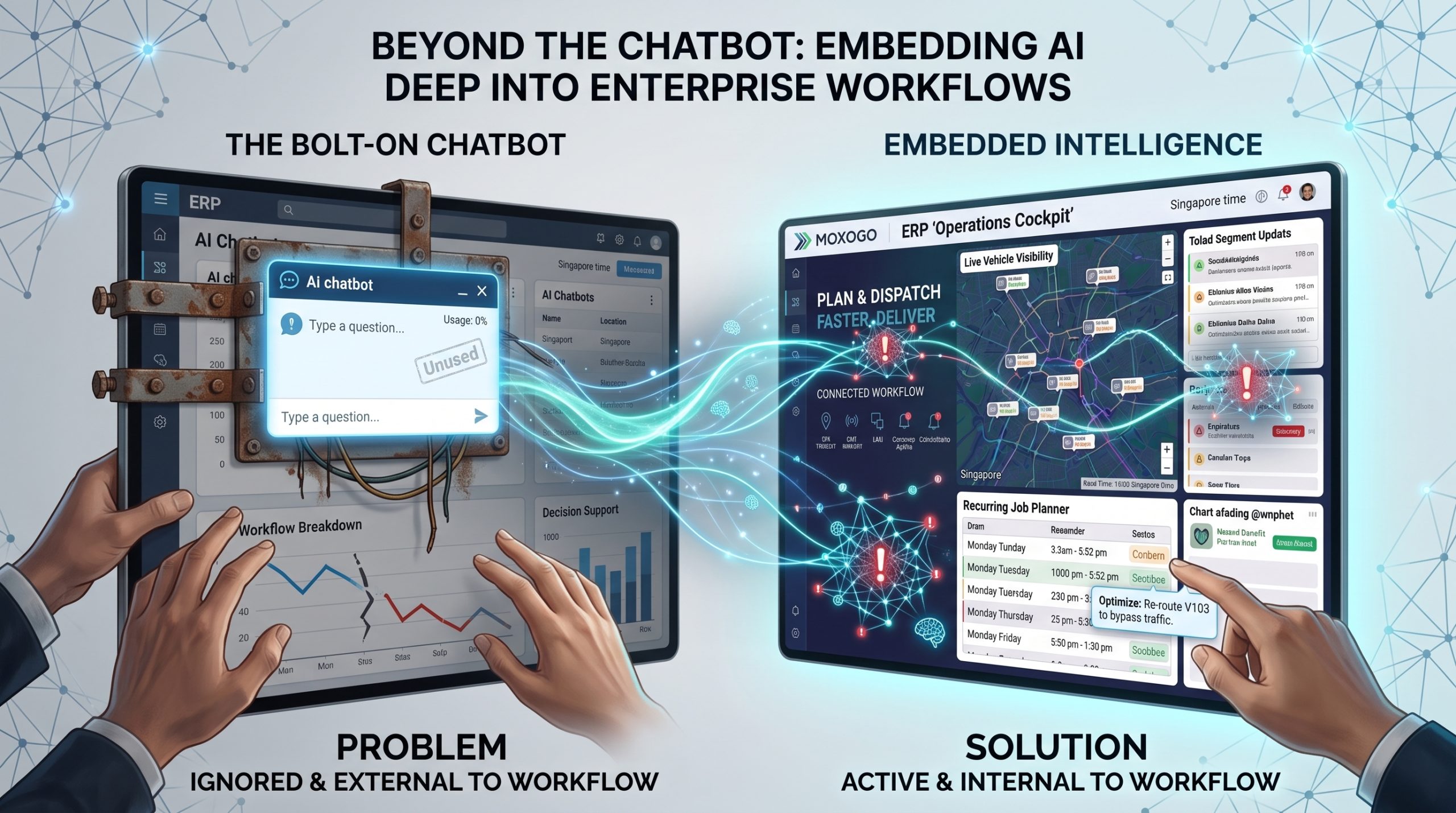
Ask most software vendors what their “AI feature” does, and the answer is almost always the same: a chat window bolted onto the corner of the screen. Type a question, get an answer, close the window, go back to doing your work exactly as you did before. It looks impressive in a demo. It changes almost nothing about how a business actually runs.
That gap between “we added AI” and “we changed how work gets done” is the real story of enterprise AI adoption right now. Most implementations stop at the first one. This article is about what it looks like to do the second, using a real operations cockpit built on top of an ERP system as the working example, and generalizing the pattern so it applies regardless of which platform or industry you are starting from.
The Problem With Bolt-On AI
A chatbot bolted onto an ERP system has a structural weakness: it sits outside the workflow. Someone has to remember it exists, open it, phrase a question, read the answer, and then act on it in a completely different screen. Every one of those steps is a place the habit breaks down. Within a few weeks, usage drops to almost zero, and the “AI feature” becomes a line item nobody mentions again.
There is also a trust problem. A general-purpose language model that was not built with knowledge of your specific database schema, access rules, or data will happily generate a plausible-sounding but wrong answer. It might invent a field that does not exist, apply a filter incorrectly, or return numbers from data the asker was never supposed to see. None of this is malicious. It is simply what happens when a general reasoning engine is connected to a specific business system without engineering the connection carefully.
The alternative is not “less AI.” It is AI embedded inside the actual place where decisions get made, constrained by the real structure of the business system underneath it, and wired into the interface people already use every day. That is a harder engineering problem than a chat window, but it is the only version that survives contact with daily use.
What Embedded AI Actually Looks Like
In practice, embedding AI into an ERP system well means working at four distinct levels, each doing a different job. None of them is a chatbot, although the first one can feel like one on the surface.
Natural language analytics, grounded in your own schema
The most visible piece is letting someone type a plain English question and get back a real answer, drawn from the operational database rather than from general knowledge. “Which customers placed the most orders this quarter” should turn into an actual chart built from actual records, not a paragraph of prose.
The way to make this safe and accurate is a two step process rather than one. First, the system asks the language model to pick which of the business’s own approved data categories the question is actually about: sales orders, tickets, purchase orders, whichever domain fits. Only then does it ask the model to build a specific query using the real field names of that category. Both outputs then get checked before anything runs: is the chosen category on an approved list, do the referenced fields actually exist in the live schema, and does the resulting filter execute without error. If any of those checks fail, the system says so plainly rather than guessing or returning something wrong that looks confident.
Crucially, the query then runs under the permissions of the person who asked it, not under some elevated system account. That single design choice removes an entire category of risk: the assistant can never show a user anything they could not already see by browsing the records directly. The final result appears as a chart with a link straight into the underlying records, so the question and the workflow never separate from each other. Someone finds an anomaly, clicks through, and is already looking at the record they need to act on.
Deterministic insights: the AI that is not AI
Not every “intelligent” observation on a dashboard needs a language model at all, and the ones that do not should not use one. A caption like “one salesperson holds nine of fourteen open opportunities, sixty four percent of the pipeline” is a plain arithmetic fact about the underlying data. Computing it with a rule rather than a model call means it is always correct, always available even if the AI provider is down, and costs nothing to generate no matter how often the dashboard refreshes.
This matters more than it might first appear. A grant reviewer, an auditor, or simply a skeptical manager will ask how you know an AI-generated number is trustworthy. The honest answer for a probabilistic language model is “we cannot guarantee it, only reduce the error rate.” The honest answer for a deterministic calculation is “because it is arithmetic.” Using deterministic logic wherever the underlying question is really just concentration, distribution, or a simple threshold check is not a compromise. It is the more rigorous choice, and it leaves the genuinely probabilistic AI budget for the questions that actually need free-form reasoning.
Alerting as the default way of managing, not an occasional feature
The single biggest productivity gain in most operational software is not a report. It is not having to go looking for the report at all. A threshold rule that watches a metric, whether that is an overdue invoice balance, a purchase approval sitting too long, or a support ticket backlog growing past a limit, and notifies the right person the moment it crosses a line, replaces an entire category of manual checking.
The engineering detail that makes this usable rather than annoying is the cooldown and re-arm logic. Without it, a breach that persists for three days sends the same notification every hour and everyone mutes it within a week. With a defined cooldown, the alert fires once, waits, and only re-notifies if the situation has not resolved. Once the metric recovers below the threshold, the rule quietly re-arms itself for next time, with no manual reset required. None of this needs a language model either. It needs good rule design and a reliable evaluation cycle, configured through a settings screen rather than written as custom code, so that operations staff can adjust thresholds themselves as the business changes.
The automated daily briefing
The last piece closes the loop between the alerting layer and the people who need a steady, calm overview rather than a stream of individual notifications. A scheduled digest, delivered before the working day starts, pulls every headline number from the same metric definitions the rest of the system uses and lays them out in one place. It costs nothing to generate, requires nobody to remember to check anything, and doubles as a running historical record of how the business has performed, since each digest is really just a snapshot in time.
The combination of these four levels is what separates a system that genuinely changes daily behaviour from one that adds a feature nobody uses after the first week. People stop hunting for information because the information finds them, in the place they already work, at the moment it becomes relevant.
The Infrastructure Question: Which AI Provider
Underneath the natural language layer sits a decision that gets less attention than it deserves: which AI provider actually answers the query. Committing to a single provider creates a dependency that is uncomfortable for two separate reasons. Pricing and rate limits change without much notice, and a provider outage becomes your outage, with no fallback.
A more resilient design supports several providers behind one internal interface, with the system able to select a suitable model automatically rather than requiring a person to hardcode a specific model name that will eventually be deprecated. If nothing is explicitly configured, the system queries the provider’s own catalogue of currently available models and picks a sensible one, caching that choice so it does not re-query on every request. A simple “test connection” action in settings lets an administrator confirm a new key works and see exactly which model was selected. For businesses with genuine data sensitivity concerns during particular periods, supporting a local, offline model as one of the options removes the need to send anything external at all when that matters most.
This is not a glamorous feature to describe, but it is one of the more important structural decisions in the whole system. It is also the kind of decision an outside reviewer, whether a grant assessor or an internal risk committee, tends to view favourably, because it demonstrates the system was designed to avoid single-vendor lock-in rather than backed into it later.
Why Governance Has to Be Designed In, Not Bolted On
Every one of the capabilities above only holds up if the underlying data handling is genuinely careful, and that has to be a property of the architecture rather than a policy document written after the fact.
Data minimisation means the AI provider never receives the actual business records. When the natural language assistant decides which fields to query, it receives field names, types, and labels, never a customer’s name, an order total, or a ticket’s contents. The reasoning happens on structural metadata; the actual numbers get retrieved afterward, directly from the database, under the requester’s own permissions.
Access right enforcement follows from that design. Because every AI-generated query executes as the asking user, with their existing permissions applied exactly as for any other action, there is no separate path by which the assistant could expose something that user could not already see through normal browsing. This is a stronger guarantee than “we told the model not to share sensitive data,” which relies on the model behaving as instructed. A permission boundary enforced by the database does not rely on the model behaving at all.
Hallucination containment is the direct answer to the most common fear about language models in a business context: that they will invent something. A model allowlist restricts which underlying models can even be called. Field validation checks every field name the model proposes against the live schema before anything executes. Executable domain checks confirm the resulting filter is actually valid before it runs against real data. An operator whitelist prevents the model from constructing filter logic outside a known safe set. None of these checks are visible to the end user, but together they mean a hallucinated field name gets caught and rejected rather than silently producing wrong numbers.
Network hardening addresses a quieter risk: that outbound calls to an AI provider could be redirected somewhere they should not go, whether through a compromised configuration or a subtle injection in the prompt itself. Pinning outbound calls to a fixed, security reviewed list of endpoints, checking DNS resolution against internal address ranges, keeping credentials in request headers rather than URLs, and applying a hard timeout on every call are unglamorous details that close off an entire class of attack most teams never think to test for.
Auditability, finally, is what turns all of the above from a design claim into something a reviewer can actually verify. Every question asked, the model that answered it, and the query that was generated get written to an immutable log. That log is not there to catch employees doing something wrong. It is there so that if a number is ever questioned six months later, there is a complete record of exactly how it was produced.
Business Intelligence Has to Come First
None of the AI layer means anything if the numbers underneath it are inconsistent. A surprisingly common failure mode in growing businesses is that two different people, looking at what should be the same metric, get two different answers, because each built their own spreadsheet with slightly different assumptions.
The fix is unglamorous but foundational: one governed definition per metric, computed once, and reused everywhere that number appears, whether that is a dashboard tile, an alert rule, a daily digest, or an exported report. Once that discipline is in place, the rest of the useful business intelligence layer follows naturally. Every metric can be compared against the same period last month or last year, with a growth indicator computed automatically. Daily snapshots build up a genuine trend history without anyone needing to remember to save a copy of anything. Every table becomes filterable, sortable, and groupable using the same interaction patterns throughout, and every row can be exported safely, with basic protections against spreadsheet formula injection built into the export path rather than left to chance.
This layer is what makes the AI capabilities trustworthy rather than merely impressive. An insight caption or an alert is only as good as the metric feeding it, and a solid, singular definition means everything built on top of it inherits that solidity.
A Phased Roadmap for AI Automation Beyond the Dashboard
Once the dashboard, alerting, and query layers are in daily use, the same underlying architecture supports a further set of automations that move from observing the business to actively assisting with decisions inside it. These tend to fall into a small number of recognisable categories, regardless of industry.
Classification and routing automation takes an incoming item, a support request, an enquiry, a document, and assigns it to the right category and team automatically, often cross-referencing an existing record such as the original sale to determine status. The gain is reduced misrouting and faster first response, since the item never waits for a person to triage it manually.
Scoring and prioritisation automation looks at open items, sales opportunities or otherwise, and ranks them using signals like time in stage, recency of engagement, and size. Surfacing that ranking where staff already work means effort naturally flows toward what matters most, rather than being spread evenly or handled in whatever order it happens to be seen.
Forecasting automation applies straightforward statistical methods to historical data to anticipate a coming pattern, most commonly a seasonal demand swing, and turns that forecast into a concrete proposal, such as an earlier reorder point, rather than leaving it as an observation someone has to remember to act on.
Anomaly and exception detection flags likely problem cases, such as a return or a dispute, from patterns in the source data, such as shipment origin or a closing warranty window. This turns a reactive process, where a problem surfaces once a customer complains, into a proactive one.
Scheduling and resource optimisation offers workload-balanced suggestions for assigning tasks to people or vehicles based on live calendars and current load, reducing the manual coordination that otherwise falls on whoever is doing the scheduling that day.
None of these require redesigning the system from scratch. They are extensions of the same governed data layer and the same interface people already use, added in phases as the business is ready for each one, rather than delivered all at once on day one.
Measuring Whether It Actually Worked
A system built this way has a genuine advantage when it comes to proving its own value: because the alert logs, daily snapshots, and query audit trail already exist, the outcome measurement does not require a separate study. It can be produced as an export.
A small set of outcome indicators tends to generalise well. Monthly reporting effort, measured in person days spent consolidating figures before the system existed against the review time needed after, usually shows the sharpest early improvement, often dropping from several days a month to well under one. Operational breach detection latency, the time between a problem starting and someone finding out, typically moves from a month end discovery process down to under an hour once alerting is live. Ad hoc question turnaround moves from a process dependent on a specific person’s availability to something closer to a minute of self-service.
Beyond those three, it is worth adding two or three metrics specific to the pain points that motivated the project, whether overdue receivables, resolution time on service requests, or approval waiting times, each with its own baseline at go live and a realistic first year target. Simple adoption tracking, how many people actually use the system in a given week, is worth measuring honestly too, because a system nobody opens has not delivered anything regardless of how sophisticated its architecture is.
What This Means for the People Doing the Work
It is worth being direct about what a project like this changes for the people using the system day to day, because the honest answer matters more than the marketing version of it. Nobody’s job becomes unnecessary. What changes is the balance between assembling information and acting on it. Staff who previously spent real time each week pulling numbers into a spreadsheet get that time back, and the natural language query capability means someone does not need to know how to write a database query to get a direct answer to a business question.
Configuring an alert rule or adding a recipient to the daily digest requires no programming ability, which means the system stays adjustable by the people who actually understand the business, not locked behind a request queue to whoever built it. That said, this only works if the underlying implementation is genuinely tested and maintained. An automated test suite protecting the core configuration against regression is not a detail for developers alone. It is what allows the team to keep tuning rules and thresholds over time without quietly breaking something else in the process.
Bringing It Together
The distance between a chatbot bolted onto an ERP system and AI genuinely embedded inside one is not really about which language model you use. It is about whether the AI sits inside the workflow where decisions happen, whether its outputs are grounded in the business’s own data and constrained by its own permission structure, and whether the business intelligence layer underneath it is disciplined enough to be trustworthy in the first place.
Get that foundation right, and the roadmap from there is genuinely incremental: a query assistant that answers real questions safely, deterministic insights that are always accurate because they are not really predictions at all, alerting that turns management into exception handling rather than constant checking, and a daily briefing that removes the need to go looking for information at all. From there, classification, scoring, forecasting, anomaly detection, and scheduling assistance are natural extensions rather than separate projects.
None of it replaces the people running the business. It removes the parts of their week that were never really about judgement, and leaves more of it for the parts that are.
More Articles

The Resource Master Audit: Why ERP Rollouts Fail at the Data Layer, Not the Software Layer
Most ERP go-lives don’t fail on features. They fail on messy master data. Here’s the Resource Master Audit that prevents it.
Read Article
The Compounding Moat: How Operational Discipline Becomes a Brand Competitors Can’t Copy
Taglines get copied overnight. Clean operational data doesn’t. How operational discipline becomes an unassailable competitive moat for SMEs. ...
Read Article
Engine and Brakes: What the Global AI Safety Debate Means for Your Business
A recurring metaphor in the global AI safety conversation, a powerful engine paired with good brakes, turns out to describe SME AI adoption just as we...
Read Article