Why Do Food Manufacturers in Singapore Need More Than Standard ERP?
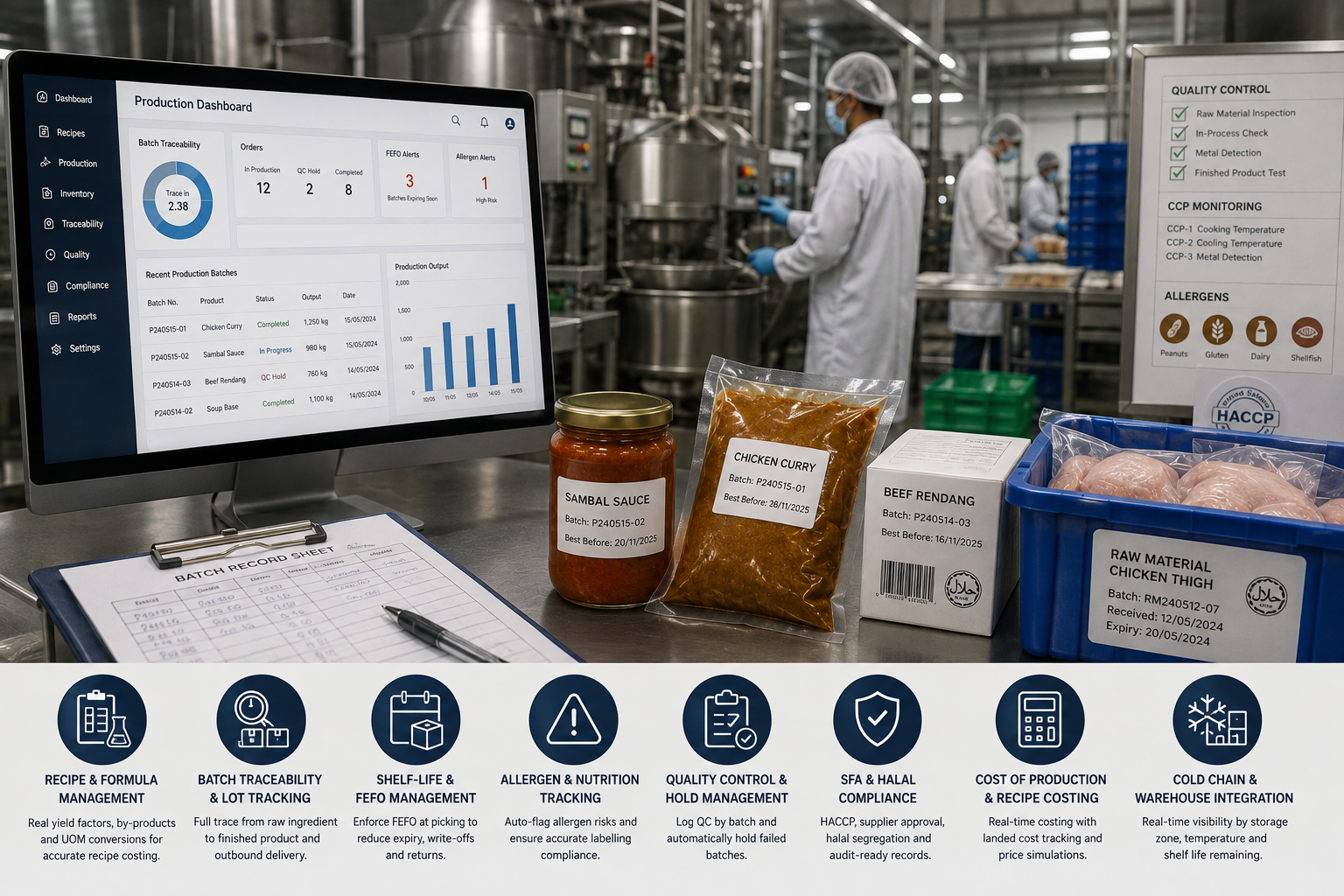
A food manufacturer in Singapore needs ERP that goes beyond inventory and accounting: recipe management with real yield factors, batch traceability from raw ingredient to finished product, FEFO-enforced shelf-life management, and allergen tracking that flags cross-contamination the moment a new ingredient is added. Standard ERP wasn’t built for any of these and the gap shows up exactly when it matters most: during a recall, an SFA audit, or a MUIS halal inspection.
Singapore’s food manufacturing sector from halal-certified producers to artisanal brands scaling into regional distribution runs on strict SFA regulations, volatile ingredient costs, and batch yields that vary every production run. If your current system can’t answer “which deliveries contain batch X of ingredient Y” within five minutes, you’re exposed. Below is what each core capability actually needs to do, and why generic ERP quietly fails at most of it.
Why Does Standard ERP Fall Short for Food Manufacturers?
Standard ERP treats a bill of materials as fixed and a unit as a unit food production is neither. A recipe’s yield changes with batch size, ingredient quality, and process conditions. A kilogram of raw ingredient doesn’t convert cleanly to a litre of finished product without a real conversion factor. And once a product ships, “where did this batch go” needs to be answerable in minutes, not after a week of chasing paper delivery notes. Generic ERP handles simple inventory reasonably well and breaks quietly on all three of these which is usually invisible until a recall or an audit forces the question.
Core Capabilities for Food Manufacturers
Recipe and Formula Management
The problem: A production recipe in food manufacturing isn’t a simple bill of materials yields vary with batch size, ingredient quality, and process conditions. Manual spreadsheet-based yield tracking can’t keep up with by-products, rework inputs, or the unit-of-measure conversions between raw ingredient and finished product.
What the ERP needs to do: Handle yield percentages, by-products, and rework inputs natively, with multiple unit-of-measure conversions built in kilograms of raw ingredient to litres of finished product, for example so recipe costing reflects what actually comes out of a batch, not a theoretical 1:1 conversion.
Batch Traceability and Lot Tracking
The problem: SFA requires that food manufacturers trace any finished product back to its raw material source within hours of a recall notification. Manual traceability spreadsheets, paper batch sheets fails at scale and fails audits the moment volume increases.
What the ERP needs to do: Link every raw material batch to every production run, and every production batch to every outbound delivery, automatically. This is the single capability that determines whether a recall takes hours or days.
Shelf-Life and FEFO Management
The problem: FIFO (First In, First Out) isn’t always right for food manufacturing. Shipping stock in arrival order instead of expiry order creates write-offs and returns that a warehouse team relying on memory will eventually miss.
What the ERP needs to do: Enforce FEFO (First Expired, First Out) automatically at the picking stage, so the stock that expires soonest ships first regardless of when it arrived, without depending on warehouse staff to catch it manually.
Allergen and Nutritional Tracking
The problem: If a raw material contains a declared allergen – peanuts, gluten, dairy, shellfish that allergen has to be tracked through every recipe that uses it and declared correctly on the finished product label. Missing this is a labelling compliance failure, not just an oversight.
What the ERP needs to do: Flag cross-contamination risk automatically the moment a new raw material is added to a recipe, so allergen declarations stay accurate without someone manually re-checking every affected product line.
Quality Control and Hold Management
The problem: Raw material inspection on receipt, in-process quality checks, and finished goods release testing all need to be logged against the relevant batch and a failed batch that isn’t blocked automatically can ship before QC catches the issue.
What the ERP needs to do: Log every QC check against its batch and place failed batches on an automatic hold, preventing shipment until QC formally resolves it not relying on someone remembering to flag it downstream.
SFA Regulatory Compliance
The problem: The Singapore Food Agency requires food businesses to implement food safety management systems, typically HACCP-based. Without structured records, supplier approval documentation and corrective action logs become the scramble that happens right before an audit instead of a standing system.
What the ERP needs to do: Support CCP (Critical Control Point) monitoring logs, corrective action records, and supplier approval documentation as standard, ongoing records not optional extras, especially for manufacturers selling through major retailers or exporting into ASEAN markets.
Halal Certification and Segregation
The problem: For halal-certified manufacturers, ingredient segregation is non-negotiable. Generic ERP systems without halal management features create certification risk by default, because they have no concept of hard segregation between halal and non-halal stock.
What the ERP needs to do: Support hard segregation of halal and non-halal ingredients, separate production runs, and documentation formatted for MUIS audit purposes built into production planning and inventory, not bolted on afterward.
Cost of Production and Recipe Costing
The problem: With commodity ingredient prices volatile, a recipe costed against last month’s purchase price is already wrong by the time it reaches a buyer conversation.
What the ERP needs to do: Provide real-time recipe costing against current raw material prices, with landed cost tracking and recipe cost simulation so you can model the impact of a 10% increase in palm oil or flour prices before you reprice, not after.
Integration with Cold Chain and Warehouse
The problem: Chilled and frozen food manufacturers carry extra complexity temperature-controlled storage zones, cold chain delivery documentation, and shorter picking windows than ambient goods allow for.
What the ERP needs to do: Give real-time visibility into stock availability by storage zone and shelf life remaining, with warehouse management integrated directly into the production ERP rather than run as a separate system.
How Moxogo Handles Traceability, Costing, and Segregation
The capability that matters most in practice, batch-to-delivery traceability, sits inside Moxogo’s Inventory & Warehouse module, which tracks manufacturer lots by barcode or serial number and attaches full document history – picking, delivery order, quality control to every batch. That’s what makes “which deliveries contain batch X of ingredient Y” a lookup instead of an investigation. The same module supports FIFO, Average Cost (AVCO), and Standard Price costing methods, so recipe costing can reflect the method that actually matches how your ingredients are bought and consumed.
On the procurement side, Purchase Management triggers requests for quotations automatically based on future needs and gives supplier and product availability visibility, relevant when volatile ingredient pricing means you’re renegotiating with suppliers more often than a standard reorder cycle would assume. And because recipe costing is only as accurate as the financial data behind it, Accounting & Finance keeps inventory valuation posted in real time, so a landed cost change flows through to your numbers immediately rather than at month-end.
What Mxgsoft Delivers for Food Manufacturers
We’ve implemented ERP for food manufacturers across Singapore from small artisanal producers scaling from 10 to 100 SKUs, to established manufacturers exporting across ASEAN. The implementation approach is the same regardless of scale: map your production process first, configure the system to match, and verify traceability end-to-end before go-live.
If your current system can’t answer “which deliveries contain batch X of ingredient Y” within five minutes, that’s the gap to close first. Talk to us about what food manufacturing ERP looks like for your operation.
Frequently Asked Questions
Why isn’t standard ERP enough for food manufacturing? Standard ERP handles inventory and accounting, but food manufacturing needs bill of materials with real yield factors, batch traceability from raw ingredient to finished product, FEFO-enforced shelf-life management, and allergen tracking, none of which generic ERP is built to handle natively.
How fast does batch traceability need to work for an SFA recall? SFA requires manufacturers to trace a finished product back to its raw material source within hours of a recall notification. If your system can’t answer which deliveries contain a specific ingredient batch within about five minutes, traceability is being handled manually and won’t hold up at scale.
What is FEFO and why does it matter more than FIFO for food manufacturers? FEFO (First Expired, First Out) ships the stock that expires soonest regardless of arrival date, unlike FIFO which ships in arrival order. For perishable food inventory, FEFO prevents the write-offs and returns that happen when soon-to-expire stock sits behind newer stock on a shelf.
How does ERP support halal certification requirements? By enforcing hard segregation of halal and non-halal ingredients, running separate production runs where required, and generating documentation formatted for MUIS audit purposes built into production planning and inventory rather than managed manually alongside a generic system.
Can ERP model the impact of rising ingredient costs before repricing? Yes, with real-time recipe costing against current raw material prices plus landed cost tracking, which lets you simulate the effect of a price increase, for example in palm oil or flour on recipe cost before you reprice with buyers, rather than discovering the impact after the fact.
Next step: Talk to us about what food manufacturing ERP looks like for your operation, starting with the traceability question that matters most: can you answer “which deliveries contain batch X of ingredient Y” in five minutes today?
More Articles
The Resource Master Audit: Why ERP Rollouts Fail at the Data Layer, Not the Software Layer
Most ERP go-lives don’t fail on features. They fail on messy master data. Here’s the Resource Master Audit that prevents it.
Read Article
The Compounding Moat: How Operational Discipline Becomes a Brand Competitors Can’t Copy
Taglines get copied overnight. Clean operational data doesn’t. How operational discipline becomes an unassailable competitive moat for SMEs. ...
Read Article
Engine and Brakes: What the Global AI Safety Debate Means for Your Business
A recurring metaphor in the global AI safety conversation, a powerful engine paired with good brakes, turns out to describe SME AI adoption just as we...
Read Article