
The Decentralized Enterprise: Navigating Corporate Governance, Digital Resilience, and Value Optimization in the Modern Economy
1. Executive Summary & The Paradigm Shift
The commercial office lease was engineered for an analog economy. In an era where corporate value was derived primarily from physical ledger books, centralized filing systems, and assembly-line administrative processing, physical proximity was a strict operational requirement. The corporate headquarters served as a physical container for data, communication, and oversight.
In today’s hyper-connected, API-first enterprise landscape, this model is rapidly becoming an obsolete relic. Value creation has shifted from physical processing to digital architecture. Data resides in secure, distributed cloud environments; workflows are orchestrated via automated integration engines; and communication is executed seamlessly through instantaneous, asynchronous networks. Despite this profound shift, a persistent cultural inertia remains within key regional business hubs, including Singapore. Enterprise evaluators, procurement boards, and traditional corporate leaders frequently rely on a legacy heuristic: equating a multi-year commercial real estate lease with corporate legitimacy, operational stability, and risk mitigation.
This whitepaper systematically deconstructs that heuristic. For sophisticated enterprises, physical real estate is no longer a valid proxy for operational excellence or financial health. In fact, a static, centralized physical footprint can introduce significant systemic vulnerabilities, inflate non-performing capital expenditures, and restrict access to global specialized talent. Modern corporate governance demands that organizations optimize for operational agility, business continuity, and capital efficiency.
A decentralized, virtual infrastructure – complemented by a strategic, agile network of premium collaborative spaces – represents a major evolution in corporate design. By decoupling core operational capability from a single geographic coordinate, forward-thinking organizations build structural resilience directly into their operating model. This framework analyzes the decentralized enterprise through the lens of modern corporate governance, institutional risk management, and the V.A.L.U.E. Framework (Volume, Accuracy, Leverage, Urgency, and Expansion). The goal is to demonstrate how a borderless, cloud-first architecture delivers superior risk mitigation and unmatched client-centric value.
2. Deconstructing the “Physical Office” Illusion
The Psychology of Trust and Legacy Heuristics
Human risk mitigation strategies have long relied on physical visibility. In traditional corporate environments, a premium commercial address in a prime financial district was viewed as a physical manifestation of creditworthiness and institutional permanence. The underlying assumption was simple: if an organization could sustain the massive overhead of a long-term commercial lease, it possessed the financial runway and institutional commitment to protect its clients from counterparty risk.
In the digital-first economy, relying on this physical proxy is a major blind spot in vendor evaluation. A physical office does not guarantee operational competence, financial stability, or strategic alignment. It simply guarantees that a significant portion of the vendor’s revenue is permanently committed to a commercial landlord. The true health of an enterprise is found in its balance sheet, its technology architecture, and its regulatory compliance records – not the square footage of its office.
The Hidden Cost Shift: Taxing the Client’s ROI
Every dollar an organization allocates to fixed, non-performing overhead is a dollar that cannot be invested in product innovation, technical accuracy, or specialized talent. Commercial real estate in prime regional hubs represents one of the highest fixed-cost line items on a corporate profit and loss statement. To sustain these unproductive assets, traditional firms must inflate their service margins.
+-------------------------------------------------------------+
| TRADITIONAL VENDOR PRICING MODEL                            |
| Total Client Fee = [Value Delivered] + [CBD Rent Overhead]  |
+-------------------------------------------------------------+
                               |
                               v
+-------------------------------------------------------------+
| DECENTRALIZED VENDOR PRICING MODEL                          |
| Total Client Fee = [Value Delivered] + [Tech Innovation]    |
+-------------------------------------------------------------+
When a client retains a vendor burdened by heavy physical real estate costs, the client is indirectly subsidizing the landlord’s equity. This represents an inefficient allocation of capital. In contrast, a decentralized enterprise eliminates this deadweight loss, allowing capital to be reinvested directly into project-specific resources, advanced automation, and elite technical talent. The client’s return on investment increases because their capital goes toward executing deliverables rather than maintaining physical real estate.
Defining Real Legitimacy in a Regulated Landscape
In a highly structured regulatory environment like Singapore, corporate legitimacy is defined by strict compliance, clear corporate governance, and digital integration – not brick-and-mortar storefronts. Real legitimacy is proven through:
- Regulatory Compliance: Active registration with the Accounting and Corporate Regulatory Authority (ACRA), regular financial audits, and consistent corporate secretarial governance.
- Structured Technical Standards: Seamless integration into national digital infrastructures, such as the InvoiceNow network, which is built on the international Peppol framework for automated e-invoicing.
- Verified Operational Frameworks: Adherence to robust, documented service level agreements (SLAs), standardized software development lifecycles (SDLCs), and transparent data processing structures.
An organization that meets these rigorous benchmarks is deeply integrated into the formal economy. Judging an enterprise by its physical office space while ignoring its digital infrastructure is a fundamental misunderstanding of modern operational risk.
3. Pillar 1: Digital Resilience & Business Continuity Governance
The Single Point of Failure (SPOF) Paradox
Traditional business continuity planning often relies on the idea of a central backup facility. However, true risk management recognizes that a centralized physical office is itself a massive Single Point of Failure (SPOF).
| Traditional Vendor Vulnerabilities | Decentralized Enterprise Resilience |
| Single Point of Failure (SPOF): Localized power, network, or building disruptions can halt operations completely. | Distributed Infrastructure: Cloud-first architecture reroutes tasks instantly to stable operational nodes. |
| Real Estate Sunk Costs: High CBD rent margins inflate project costs without adding technical value. | Direct Capital Injection: Capital is reinvested directly into hyper-automation and elite technical specialists. |
| Geographic Talent Bottleneck: Hiring is limited to professionals within standard commuting distance. | Borderless Execution: Sourcing and deploying specialized global talent based on technical alignment. |
When an organization concentrates its entire workforce within a single physical footprint, it exposes its clients to localized operational disruptions. Power grid failures, localized telecommunication outages, building maintenance issues, and physical security threats can instantly freeze operations. If team members cannot access the physical building, client-facing workflows ground to a halt.
The Cloud-First, Distributed Architecture
A decentralized enterprise eliminates the vulnerability of a single physical location by building operational redundancy into its design. By utilizing enterprise-grade cloud environments, global content delivery networks (CDNs), and highly resilient communication infrastructures, the firm ensures its core operations are entirely untethered from any single geographic coordinate.
Under this model, business continuity is maintained automatically. If a team member encounters a localized power or network disruption, their workflows can be instantly reassigned to another node within the distributed network. This cloud-first approach guarantees continuous operational uptime. The organization ceases to be a vulnerable physical target and becomes an adaptable digital network, safeguarding client projects from unexpected real-world disruptions.
Advanced Security and Corporate Data Governance
A common objection to decentralized operations centers on data security. Traditional mindsets assume that data is only secure if it is processed inside a physical office guarded by a security badge reader. In reality, physical walls offer little protection against modern cyber threats. True data governance relies on advanced digital security architectures.
Decentralized organizations implement zero-trust security frameworks that often surpass the security capabilities of standard local area networks inside a traditional office. These security measures include:
- Identity and Access Management (IAM): Enforcing strict, role-based access control (RBAC) integrated with multi-factor authentication (MFA) to ensure only verified personnel can access client data.
- Secure Endpoint Management: Utilizing enterprise mobility management (EMM) and virtual desktop infrastructure (VDI) to secure data at rest and in transit, regardless of the user’s physical location.
- Comprehensive Audit Logging: Tracking all data access, system modifications, and communication flows through immutable, cloud-based audit logs, ensuring absolute transparency and compliance with data protection standards like the Personal Data Protection Act (PDPA).
Security is a function of system architecture, encryption protocols, and access management – not physical real estate.
4. Pillar 2: Capital Efficiency & Direct Value Injection
Strategic Capital Allocation: Optimizing the Corporate Balance Sheet
Corporate governance requires boards and executive teams to maximize shareholder value and client outcomes through smart capital allocation. When capital is tied up in long-term commercial lease obligations – often requiring significant security deposits and fixed monthly outlays – it limits financial flexibility.
By shifting from fixed physical expenses to a variable, on-demand operational model, a decentralized enterprise frees up valuable capital. This capital is then redirected into high-ROI assets that directly improve client outcomes:
- Hyper-Automation Systems: Building advanced integration infrastructure using platforms like n8n or Make to automate complex, repetitive workflows.
- Enterprise Resource Planning (ERP): Deploying comprehensive ERP architectures, such as Odoo v18/v19, to unify data structures and streamline operations.
- Technical Upskilling: Investing heavily in ongoing technical training and certifications for engineering and architecture teams.
This capital shift converts non-performing real estate overhead into active, high-performing technical capabilities.
Driving Value via the V.A.L.U.E. Framework
The financial advantages of a decentralized enterprise translate directly into measurable benefits for the client. This value delivery model can be analyzed through five core vectors:
| Vector | Traditional Real-Estate Bound Firm | Decentralized Enterprise |
| Volume | Scalability is bottlenecked by physical desk space, local hiring constraints, and high fixed costs. | Scalability is virtually limitless; computing power and system capacity expand dynamically in the cloud. |
| Accuracy | Prone to human error due to reliance on manual processing by localized, administrative staff. | High accuracy achieved through end-to-end automation, systemic validation rules, and API integrations. |
| Leverage | Low operational leverage; expanding output requires hiring more physical staff, increasing costs. | High operational leverage; a lean team of elite architects can manage large-scale deployments via technology. |
| Urgency | Response times are limited by physical office hours, commute times, and localized operational schedules. | Fast, round-the-clock execution enabled by distributed networks and asynchronous workflows. |
| Expansion | Data and revenue opportunities are restricted to local markets and siloed physical ecosystems. | Unlocks new revenue streams and data models by integrating global insights and borderless systems. |
By eliminating the financial drag of physical offices, the decentralized enterprise maximizes performance across all five vectors, providing clients with an agile, high-efficiency partner.
5. Pillar 3: Cross-Border Talent Access & Borderless Execution
Overcoming the Local Talent Constraint
For knowledge-intensive industries, digital transformation, and enterprise software engineering, the primary driver of project success is the caliber of the technical team. In major global business hubs like Singapore, the local market faces structural challenges: a highly competitive tech talent pool, rapid turnover, and skyrocketing acquisition costs for specialized skill sets.
A traditional firm that requires its employees to sit at physical desks in a specific office limits its hiring pool to individuals living within commuting distance. This geographic restriction makes it difficult to secure highly specialized talent.
The decentralized model eliminates this geographic bottleneck. By adopting a remote-first, borderless hiring architecture, the enterprise can source, onboard, and deploy elite specialists from around the globe. Whether a project requires a top-tier ERP architect, a highly specialized automation engineer, or an advanced data analyst, the organization can build the optimal team based on merit and technical alignment rather than geographic proximity.
Geographically Bound Model:
+-------------------------------------------------------------+
| Local City Limits (Restricted Talent Pool & High Cost)      |
|   [Vendor Office] <--- Only hires within commuting distance |
+-------------------------------------------------------------+

Borderless Decentralized Model:
+-------------------------------------------------------+
| Global Talent Ecosystem (Unrestricted & Specialized)  |
|   [Cloud Workspace]                                   |
|      ├── Specialist Node (Singapore - Core Strategy)  |
|      ├── Engineering Node (Region-Specific Expertise) |
|      └── Architecture Node (Global Domain Experts)    |
+-------------------------------------------------------+
Asynchronous Mastery and Continuous Execution
Managing a cross-border, distributed team requires moving away from traditional, presence-based management toward asynchronous execution. Traditional operations rely on synchronous communication – meetings, immediate chat responses, and physical check-ins – which frequently disrupt deep focus work.
Asynchronous mastery prioritizes comprehensive documentation, clear task ownership, and structured communication protocols. Work is managed via clear specifications, explicit completion criteria, and centralized project management repositories. This approach minimizes administrative drag and unlocks a continuous execution model.
When a team is distributed across complementary time zones, a project can move forward around the clock. Local strategy teams can define requirements and align with clients during the day in Singapore. As their day concludes, global engineering nodes take over to handle development, testing, and system optimization. The next morning, the local team reviews completed, verified outputs ready for client presentation. This model compresses project timelines and accelerates time-to-market, all without requiring a single physical office desk.
6. The New Collaboration Standard: Premium Hot-Desking & Client-Centric Face Time
Recommitting to Cultivated, Agile Nodes
Moving away from a traditional lease does not mean abandoning physical collaboration. Instead, it shifts the focus to high-quality, intentional presence. The decentralized enterprise replaces fixed, underutilized office spaces with a nimble strategy based on premium, agile coworking networks.
Under this model, the organization utilizes professional workspaces, such as those provided by premier global and regional coworking networks. These platforms offer state-of-the-art enterprise infrastructure, enterprise-grade network security, and fully equipped boardrooms on demand.
This is a strategic choice, not a compromise. It allows the organization to scale its physical footprint up or down instantly based on actual project needs. The firm avoids paying for empty desks and dark conference rooms, keeping its operational capital lean and focused on value delivery.
Meeting the Client on Their Terms
In traditional consulting models, the client is frequently expected to travel to the vendor’s office for formal reviews, design sessions, and alignment meetings. This model values the vendor’s real estate asset over the client’s time and convenience.
A decentralized architecture reverses this dynamic, placing the client at the center of the relationship. Because the enterprise has access to a network of premium collaborative nodes across the region, physical meetings can be scheduled at the location that best suits the client.
Traditional Approach:
[Client Team] ----(Commute Across City)----> [Vendor's Fixed CBD Office]

Client-Centric Decentralized Approach:
[Client Office / Node]
          ^
          | (Vendor deploys to the closest premium agile boardroom)
[Agile Workspace Node A]  or  [Agile Workspace Node B]  or  [Direct-to-Client]
Whether a meeting is best hosted near the client’s operational headquarters, in a central financial district boardroom, or within a specific regional industrial hub, the decentralized firm can open a premium collaborative node nearby. This flexibility respects the client’s schedule, minimizes travel friction, and demonstrates an agile, customer-first approach.
Deep Work vs. Strategic Synchronous Alignment
High-performance execution requires balancing deep, uninterrupted focus with highly collaborative alignment. Traditional open-plan offices often struggle to provide this balance, exposing teams to constant ambient noise and frequent visual distractions that degrade cognitive performance.
The decentralized model establishes a clear separation between these two working modes:
- Deep Focus Work: Technical engineering, complex database design, script optimization, and architectural blueprinting are performed in highly optimized, distraction-free remote environments. Team members can control their surroundings to maximize focus and eliminate cognitive context-switching.
- Strategic Synchronous Alignment: High-stakes brainstorming sessions, complex system blueprinting, and critical project launch alignments are held in premium physical boardrooms.
By separating routine execution from strategic alignment, both modes become more effective. Physical meetings are no longer a default habit for daily status updates; they are saved for high-value collaborative milestones, maximizing the impact of face-to-face time.
7. Conclusion & Actionable Framework for Evaluators
The Evolution of Enterprise Assessment
The business world is moving away from physical proxies toward digital verification. Enterprise leaders, procurement officers, and technology evaluators must update their vendor assessment frameworks to match this reality. Judging an execution partner by the size of their physical office lease is an outdated approach that introduces unnecessary risk and compromises capital efficiency.
True corporate resilience is found in the strength of an organization’s digital architecture, the clarity of its governance frameworks, and the accuracy of its automated workflows. A beautiful physical office space sitting on top of a fragmented, manual, and fragile operational database is simply a shiny coffin.
Progressive organizations evaluate potential partners by inspecting their digital core:
- Does the vendor maintain robust, automated systems that protect project delivery from human error?
- Do they possess a secure, distributed cloud infrastructure that ensures business continuity under any conditions?
- Are they leveraging global talent to deliver the best possible results?
The decentralized enterprise answers these questions with a resounding yes, offering a resilient, modern model designed for the digital economy.
Evaluation Checklist for Modern Technology Vendors
To help your procurement teams move past physical office bias and objectively assess vendor capabilities, use this digital resilience and governance matrix:
| Evaluation Vector | Red Flag (Legacy Model) | Green Flag (Decentralized Enterprise) | Verified Assessment Method |
| Operational Continuity | Single physical location with local servers; team operations halt during building disruptions. | Distributed cloud architecture with automated node reassignments and 99.9% uptime guarantees. | Request Business Continuity Plan (BCP) and system uptime reports. |
| Data Governance & Security | Data security relies primarily on physical building access and basic local area networks. | Zero-trust security frameworks, mandatory multi-factor authentication (MFA), and automated audit logs. | Inspect IAM policies and compliance records (e.g., PDPA, SOC2 frameworks). |
| Capital Performance | High percentage of service fees goes to subsidizing commercial real estate overhead. | Capital is focused on tech innovation, automation (n8n/Make), and technical expertise. | Analyze vendor fee structures against direct project resource allocations. |
| Talent Acquisition | Recruitment is geographically limited to candidates within a local commuting radius. | Global talent access with asynchronous workflows and specialized cross-border nodes. | Review core project team profiles and specialized technical certifications. |
| Digital Integration | Relies on manual paper processing, physical mail delivery, and outdated file sharing. | Fully integrated into digital standards like InvoiceNow/Peppol and API-first architectures. | Verify active ACRA standings and digital integration capabilities. |
To make this session highly actionable, we need to move past theoretical concepts and focus directly on your operational data. The goal is to isolate your highest-friction workflows, analyze them using the V.A.L.U.E. Framework, and build a clean roadmap that eliminates technical debt.
Here is the structured blueprint we will follow to run this strategic system review.
Strategic System Review Architecture
Phase 1: Operational Ingestion (Pre-Session)
Before we meet in the boardroom, we need to gather raw data from your current operational state. This prevents the session from turning into a series of vague discussions. We will focus on mapping:
- Your current software stack and database touchpoints (e.g., legacy systems, scattered spreadsheets, or disjointed apps).
- Your high-frequency internal tasks that consume more than 10 hours of staff time per week.
- Your primary communication bottlenecks between cross-border teams or external clients.
Phase 2: The V.A.L.U.E. Diagnostic Workshop (In-Session)
We will run each core workflow through a strict five-part filter to determine exactly where your systems are losing efficiency:
                  THE V.A.L.U.E. DIAGNOSTIC MATRIX
   +-------------------------------------------------------------+
   |  VOLUME    --> Is this a repetitive, high-frequency task?   |
   |  ACCURACY  --> Where do manual entry human errors occur?    |
   |  LEVERAGE  --> Can 1 architect do the work of 10 using tech?|
   |  URGENCY   --> Does this bottleneck solve a "bleeding neck"?|
   |  EXPANSION --> Does this unlock clean, structured data?     |
   +-------------------------------------------------------------+
- Volume: We will isolate repetitive data-entry processes (such as manual invoicing or inventory tracking) that are prime candidates for end-to-end automation.
- Accuracy: We will find where manual copy-pasting happens. Every manual step is a point of failure; we want to replace these with secure API integrations.
- Leverage: We will review your team’s output density. We want to ensure your senior architects are focused on high-value delivery rather than managing administrative tasks.
- Urgency: We will prioritize your most critical operational bottlenecks – the ones causing delays in client delivery or impacting cash flow.
- Expansion: We will check your database health. We need to make sure your data flows cleanly into systems like Odoo or n8n so you can scale without creating a cluttered IT landscape.
Phase 3: The Integration Roadmap (Post-Session)
We will compile the workshop findings into a direct, fluff-free blueprint containing:
- An As-Is vs. To-Be system architecture map.
- An automation and ERP deployment schedule prioritized by immediate ROI.
- A clear risk-mitigation plan to ensure your data transitions smoothly without interrupting daily operations.
1.Select Location & Time:Immediate.
Choose a premium collaborative boardroom that fits your team’s schedule, or let’s coordinate a secure virtual workshop session.
2.Extract Workflow Data:3 days before session.
Compile a list of your top 3 highest-friction workflows and a basic map of your current software toolstack.
3.Execute Strategy Workshop:Scheduled Date (2 Hours).
Run the live V.A.L.U.E. diagnostic to isolate system gaps and map out your automation opportunities.
To get this scheduled, what are 2 or 3 preferred dates and times that work best for your team over the next fortnight?
More Articles
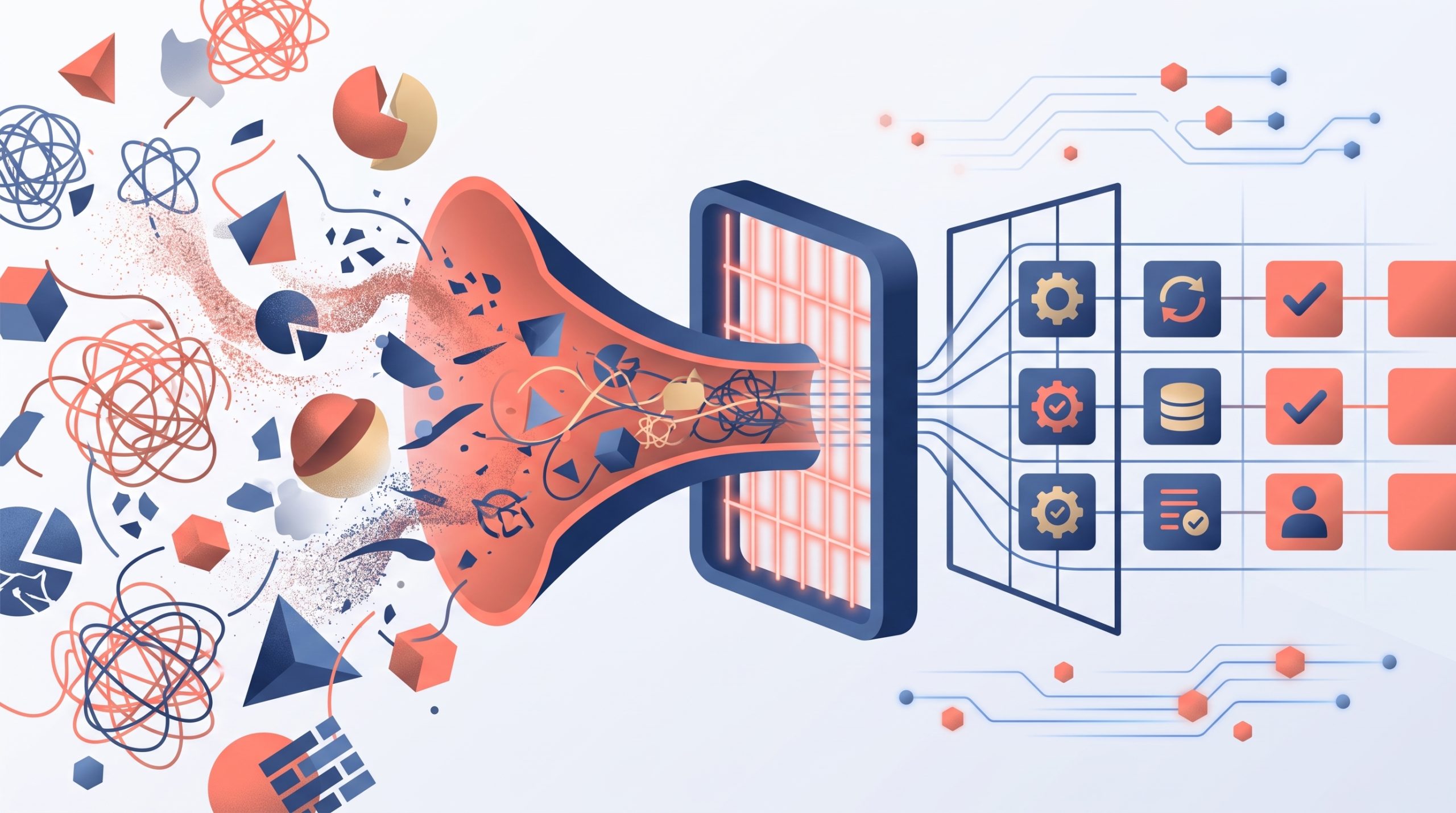
The Resource Master Audit: Why ERP Rollouts Fail at the Data Layer, Not the Software Layer
Most ERP go-lives don’t fail on features. They fail on messy master data. Here’s the Resource Master Audit that prevents it.
Read Article
The Compounding Moat: How Operational Discipline Becomes a Brand Competitors Can’t Copy
Taglines get copied overnight. Clean operational data doesn’t. How operational discipline becomes an unassailable competitive moat for SMEs. ...
Read Article
Engine and Brakes: What the Global AI Safety Debate Means for Your Business
A recurring metaphor in the global AI safety conversation, a powerful engine paired with good brakes, turns out to describe SME AI adoption just as we...
Read Article